
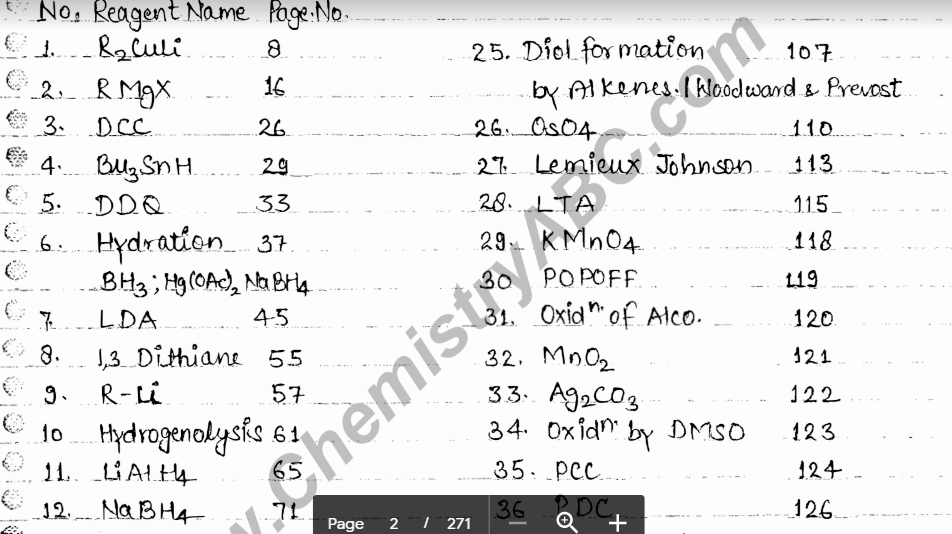
Downloading verified reagents handwritten notes is the most effective way for aspirants to master functional group transformations in organic synthesis. In competitive examinations like CSIR-UGC NET Chemical Sciences and GATE Chemistry (CY), questions on reagents carry significant weightage across Part B and Part C.
To help you prepare systematically, we are sharing comprehensive reagents handwritten notes compiled from top rankers. These notes cover everything from mild oxidizing agents to modern transition-metal catalyzed cross-couplings. You can also download our related Organic Chemistry Topper Notes PDF for complete syllabus coverage.
Why Reagents Handwritten Notes Are Essential for CSIR NET & GATE
Organic synthesis questions evaluate chemo-, regio-, and stereoselectivity. Having structured reagents handwritten notes helps you remember selectivity rules without confusion during the exam:
| Exam & Section | Typical Questions | Marks Weightage | Frequent Themes & Transformations |
|---|---|---|---|
| CSIR NET Part B | 2 to 3 Questions | 4 to 6 Marks | Direct functional group interconversions, chemoselective oxidations, simple reductions. |
| CSIR NET Part C | 4 to 6 Questions | 16 to 24 Marks | Multi-step cascade syntheses, asymmetric reductions (Noyori, CBS), organometallic cross-couplings. |
| GATE Chemistry (CY) | 5 to 7 Questions | 8 to 12 Marks | MSQ and NAT problems involving selective protecting groups, enolate alkylations, and organoboranes. |
Core Summary: Organic Chemistry Reagents at a Glance
Here is a quick summary table extracted from our high-yield reagents handwritten notes:
| Reagent Category | Key Reagents | Target Functional Transformation | Regio- & Stereochemical Notes |
|---|---|---|---|
| Selective Oxidizing Agents |
• Dess-Martin (DMP) • PCC / PDC • m-CPBA • OsO4 / NMO |
1° alcohol → aldehyde; 2° alcohol → ketone. Alkene → Epoxide. Alkene → syn-1,2-diol. | Mild, non-acidic conditions. Epoxidation occurs from the less hindered face of double bonds. |
| Chemoselective Hydride Reductions |
• DIBAL-H (−78 °C) • NaBH4 / CeCl3 (Luche) • LiAlH4 • Red-Al |
Esters / Nitriles → Aldehydes. α,β-unsaturated ketone → allylic alcohol (1,2-reduction). Esters, acids, amides → alcohols / amines. | Luche reagent prevents conjugate 1,4-reduction. Low-temperature DIBAL-H stops at the stable tetrahedral intermediate. |
| Organometallic & C−C Forming |
• Gilman (R2CuLi) • LDA (−78 °C) • Simmons-Smith (CH2I2, Zn-Cu) • Grignard (RMgX) |
Conjugate 1,4-addition on enones. Kinetic enolate generation. Stereospecific cyclopropanation of alkenes. | Soft nucleophile adds 1,4. Directed by adjacent allylic hydroxy groups in cyclic systems. |
| Modern Transition-Metal Catalysts |
• Pd(PPh3)4 (Suzuki) • Grubbs Catalyst • Wilkinson Catalyst • Heck Catalyst |
Aryl halide + Boronic acid → Biaryl. Olefin metathesis (RCM, ROMP). Homogeneous selective alkene hydrogenation. | Retains double bond stereochemistry. Minimal steric congestion controls hydrogenation rates. |
Topics Covered in These Reagents Handwritten Notes
- Selective Oxidations: Swern oxidation, Corey-Kim, Jones reagent, TEMPO, CAN (Cerium Ammonium Nitrate), selenium dioxide (SeO2 allylic oxidation), and Prevost/Woodward dihydroxylations.
- Selective Reductions: Birch reduction (electron-withdrawing vs electron-donating substituents), catalytic hydrogenation (H2/Pd-C, Lindlar catalyst), Wolff-Kishner, Clemmensen, and dissolved metal reductions.
- Organoboranes & Organosilicon: Hydroboration-oxidation (9-BBN, disiamylborane), allylic silanes (Hosomi-Sakurai reaction), and Peterson olefination (acidic vs basic stereochemical outcome).
- Sulfur & Phosphorus Ylides: Wittig olefination (stabilized vs unstabilized ylides, Schlosser modification) and Corey-Chaykovsky reaction (epoxide vs cyclopropane selectivity).
- Protecting Groups: Cleavage and installation conditions for acetals, ketals, silyl ethers (TBS, TBDPS, TMS), benzyl ethers, and carbamates (Boc, Cbz, Fmoc).

Download Reagents Handwritten Notes PDF
Choose your preferred download server below to access the full 15 MB PDF study booklet containing comprehensive reagents handwritten notes:
Explore Related Chemistry Study Materials & Mock Tests
Educational Fair Use Notice: ChemistryABC.com provides free educational resources to assist students preparing for national competitive examinations. We encourage students to study standard literature such as Organic Synthesis on Wikipedia and prescribed university textbooks. For queries, contact us at [email protected].
Frequently Asked Questions (FAQs)
Which organic reagents carry the highest weightage in CSIR NET Chemical Science?
Key reagents include organolithiums and Gilman reagents (LDA, R2CuLi), chemoselective hydrides (DIBAL-H, Luche reagent, Red-Al), hypervalent iodine oxidants (Dess-Martin Periodinane, IBX), and palladium-catalyzed cross-couplings (Suzuki, Heck, Sonogashira).
How does DIBAL-H selectively reduce esters to aldehydes without over-reduction?
At low temperatures (−78 °C), Diisobutylaluminium hydride (DIBAL-H) forms a stable, neutral tetrahedral intermediate that resists further reduction until aqueous workup hydrolyzes it to the aldehyde.
What is the difference between 1,2- and 1,4-reduction in α,β-unsaturated enones?
Hard hydrides like LiAlH4 attack the carbonyl carbon directly (1,2-addition), yielding allylic alcohols. Soft hydrides like NaBH4 in ethanol often yield mixtures. Adding Cerium(III) chloride (Luche reduction) ensures selective 1,2-reduction.

you all can ask for notes via commenting here!
Amazing nots thats is very useful for me thanks sir
really
Thank you Sir ?
Best helpful site in chemistry
Best site in chemistry
thank you sir
sir a small doubt what is spp