

CSIR NET & GATE Photochemistry Handwritten Notes in PDF
Accelerate your competitive exam preparation with comprehensive classroom handwritten notes. Covers Jablonski diagram, fluorescence vs. phosphorescence, Stern-Volmer quenching kinetics, Norrish Type I & II reactions, and Paterno-Büchi photocycloadditions.
- 1. Document Specifications & Syllabus Weightage
- 2. Physical Photochemistry: Jablonski Diagram & Photophysical Processes
- 3. Stern-Volmer Quenching Kinetics & Quantum Yield
- 4. Organic Photochemistry: Key Reaction Blueprints (Norrish, Paterno-Büchi)
- 5. Solved CSIR NET & GATE Practice Problems
- 6. Handwritten Notes Page Preview
- 7. Frequently Asked Questions (FAQs)
- 8. Direct High-Speed Download Mirror
📚 1. Document Specifications & Syllabus Weightage
In CSIR NET Chemical Science and GATE (CY), Photochemistry spans both physical and organic chemistry, contributing 12 to 18 marks across Part B and Part C. Questions test both numerical calculation (quantum yield, fluorescence lifetime, Stern-Volmer constant) and mechanistic prediction (biradical intermediates, stereochemical outcomes).
| Module Name | Photochemistry Complete Classroom Notes (Organic + Physical) |
|---|---|
| Target Examinations | CSIR UGC NET (JRF/LS), GATE Chemistry (CY), BARC, TIFR, SET |
| File Size & Quality | ~3 MB • High-contrast scanned PDF (Optimal readability on screen & print) |
| Authors / Source | Curated from Premier Coaching Class Notes & NET Toppers |
| Access Cost | 100% Free Direct Google Drive Download |
🔬 2. Physical Photochemistry: Photophysical Pathways
- Grotthuss-Draper Law: Only the radiation absorbed by a chemical system is effective in bringing about a photochemical transformation.
- Stark-Einstein Law of Photochemical Equivalence: Each molecule taking part in a primary photochemical reaction absorbs exactly one quantum (photon) of light.
- Lambert-Beer Law: Absorbance A = log10(I0 / I) = ε · c · l, where ε is the molar absorption coefficient.
| Transition Name | Process Type | Spin Multiplicity Change | Typical Timescale (τ) | Emission of Light |
|---|---|---|---|---|
| Internal Conversion (IC) | Non-Radiative | Iso-multiplicity (Sn → Sn−1) | 10−12 to 10−11 s | No (Heat dissipated to solvent) |
| Intersystem Crossing (ISC) | Non-Radiative | Spin-Forbidden (S1 → T1) | 10−10 to 10−8 s | No (Enhanced by heavy-atom effect) |
| Fluorescence (F) | Radiative Emission | Spin-Allowed (S1 → S0 + hνF) | 10−9 to 10−7 s | Yes (Fast emission, stops when light stops) |
| Phosphorescence (P) | Radiative Emission | Spin-Forbidden (T1 → S0 + hνP) | 10−3 to several seconds | Yes (Delayed emission, persists after light stops) |
Stokes Shift: Fluorescence emission wavelength is consistently longer than absorption wavelength (λemission > λabsorption) due to rapid vibrational relaxation in S1.
⚡ 3. Stern-Volmer Quenching Kinetics & Quantum Yield
• Chain reactions (e.g., H2 + Cl2): Φ ≈ 104 – 106 (Very high)
• Non-chain reactions with deactivation: Φ ≤ 1
In the presence of a quencher [Q], fluorescence intensity decreases according to the Stern-Volmer relation:
Where:
KSV = Stern-Volmer quenching constant (Slope of I0/I vs. [Q] plot)
kq = Bimolecular quenching rate constant (L mol−1 s−1)
τ0 = Natural fluorescence lifetime in the absence of quencher
🧪 4. Organic Photochemistry: High-Frequency Reactions
1. Norrish Type I (α-Cleavage)
Photochemical homolytic cleavage of the bond between the carbonyl carbon and the α-carbon, generating an acyl-alkyl biradical pair. Favored in strained cyclic ketones (cyclobutanone, cyclopentanone) and in the vapor phase, leading to decarbonylation (−CO).
2. Norrish Type II (γ-H Abstraction)
Carbonyl compounds containing a γ-hydrogen undergo intramolecular hydrogen abstraction through a 6-membered cyclic transition state, generating a 1,4-biradical. Leads to either fragmentation (alkene + enol) or cyclization to cyclobutanols (Yang reaction).
3. Paterno-Büchi Reaction
Photochemical [2 + 2] cycloaddition between an excited carbonyl compound and an alkene to form an oxetane ring. Singlet excited state adds stereospecifically, while triplet excited state forms a long-lived biradical yielding thermodynamically stable regioisomers.
4. Di-π-Methane Rearrangement
Molecules containing two π-systems separated by an sp3 hybridized carbon (1,4-dienes or β,γ-unsaturated ketones) undergo photochemical isomerization to produce vinylcyclopropanes or cyclopropyl ketones.
💡 5. Solved CSIR NET & GATE Practice Problems
Problem 1: The fluorescence lifetime of a fluorophore in the absence of quencher is τ0 = 10 ns. In the presence of 0.02 M quencher [Q], the fluorescence intensity drops by 50% (i.e., I0 / I = 2). Calculate the bimolecular quenching rate constant (kq).
Step-by-Step Solution:
- Apply the Stern-Volmer relation: I0 / I = 1 + kq τ0 [Q].
- Substitute the given values:
2 = 1 + kq × (10 × 10−9 s) × (0.02 mol L−1)
1 = kq × (2 × 10⁻¹⁰ mol s L−1) - Solve for kq:
kq = 1 / (2 × 10⁻¹⁰) = 5.0 × 10⁹ L mol−1 s−1. - Conclusion: Since kq ≈ 1010 L mol−1 s−1, the process is diffusion-controlled dynamic quenching.
Problem 2: Predict the major photoproducts when 2-hexanone [CH3COCH2CH2CH2CH3] is irradiated with UV light (λ = 313 nm).
Step-by-Step Mechanism:
- 2-Hexanone possesses γ-hydrogens on the butyl chain: CH3−C(=O)−CH2(α)−CH2(β)−CH2(γ)−CH3.
- Upon photoexcitation, the carbonyl oxygen in the (n, π*) state abstracts a γ-hydrogen via a 6-membered cyclic chair-like transition state, producing a 1,4-biradical.
- Path A (Fragmentation): The α,β-bond cleaves, yielding propene (CH3CH=CH2) and an enol [CH2=C(OH)CH3], which tautomerizes rapidly to acetone (CH3COCH3). This is the dominant Norrish Type II process.
- Path B (Cyclization): Radical recombination forms 1-methyl-2-propylcyclobutanol (Yang cyclization product).
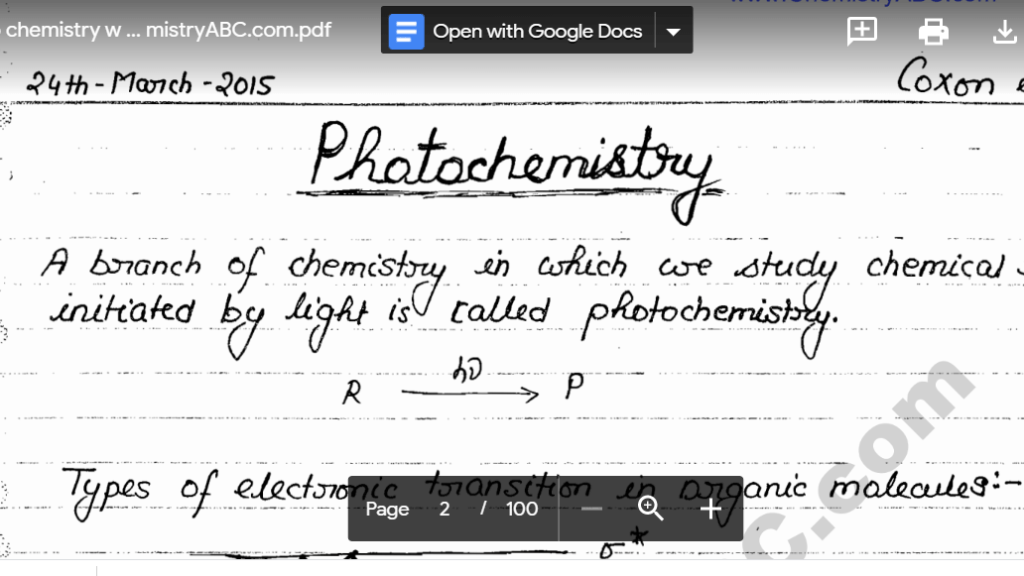
🖼️ 6. Handwritten Notes Page Preview
Below is a sample preview from the high-resolution scanned PDF notes:
❓ 7. Frequently Asked Questions (FAQs)
Fluorescence is a spin-allowed transition (S1 → S0, ΔS = 0) with a very short lifetime (τ ≈ 10−9 s). Phosphorescence is a spin-forbidden transition (T1 → S0, ΔS ≠ 0), requiring an electron spin flip, which significantly lowers the transition probability and results in a long lifetime (τ ≈ 10−3 s to minutes).
In dynamic (collisional) quenching, increasing temperature increases diffusion rates and collision frequency, thereby increasing KSV. In static quenching (ground-state complex formation), increasing temperature dissociates the complex, thereby decreasing KSV.
Yes. These notes thoroughly cover both Physical Photochemistry (quantum yields, actinometry, decay kinetics) and Organic Photochemistry (rearrangements, photocycloadditions, biradical mechanisms), perfectly aligning with CSIR NET Part B & C and GATE CY syllabus requirements.
Download Complete Photochemistry Notes (PDF)
File Size: ~3 MB • High-Speed Direct Google Drive Mirror
📥 FREE DOWNLOAD PHOTOCHEMISTRY PDFEducational Disclaimer: ChemistryABC.com provides educational resources and classroom notes strictly for self-study and competitive examination preparation. All copyrights and trademarks belong to their respective authors and institutions. We encourage students to support original authors by purchasing published textbooks.
For queries, copyright notices, or suggestions, please contact us at: [email protected]


Count me amongst those who appreciate your endeavors . Certainly we are marching for a better tomorrow.
Sir PLZZ provide me notes of msc final year inorganic chemistry of all books..
ok i am preparing it. if you pleased then provide your past semester notes too! thanx. ChemistryABC team.
Adding ASAP!
Sir m.sc general chemistry notes pettandi sir
we will add it shortly if in luck.