

Chemical & Statistical Thermodynamics Handwritten Notes PDF
Master the most scoring mathematical unit of physical chemistry. High-yield handwritten classroom notes covering Maxwell relations, partition functions, residual entropy, and solved CSIR NET & GATE questions.
- 1. File Specifications & Syllabus Coverage
- 2. Classical Thermodynamics: Maxwell Relations & Equations of State
- 3. Thermodynamic Square Mnemonic (Maxborn Relations)
- 4. Statistical Thermodynamics: Partition Functions & Ensembles
- 5. Hierarchy of Energy Level Spacings & Partition Functions
- 6. Solved Benchmark CSIR NET Part-C Questions
- 7. Classroom Notes Sample Page Preview
- 8. Frequently Asked Questions (FAQs)
- 9. Direct High-Speed Download Mirror
📚 1. File Specifications & Exam Weightage
Thermodynamics (Classical + Statistical) represents 25 to 35 marks in CSIR NET Chemical Science and 8 to 12 marks in GATE (CY). Because the questions are direct application of fundamental formulas, this unit yields nearly 100% accuracy with systematic revision.
| Module Name | Chemical and Statistical Thermodynamics (Career Notes) |
|---|---|
| Target Exams | CSIR UGC NET (JRF/LS), GATE Chemistry (CY), BARC, TIFR, SET, M.Sc./B.Sc. |
| File Size & Format | 7.4 MB • High-Resolution PDF (High-contrast, clean printer scan) |
| Authors / Source | Curated by Top Rankers of CSIR NET & GATE Chemical Sciences |
| Access Cost | 100% Free Direct Download via Google Drive |
⚖️ 2. Classical Thermodynamics: Fundamental Equations
Enthalpy: dH = T dS + V dP
Helmholtz Energy: dA = −S dT − P dV
Gibbs Free Energy: dG = −S dT + V dP
| Origin Potential | Maxwell Relation | Physical Significance |
|---|---|---|
| Internal Energy (U) | (∂T/∂V)S = −(∂P/∂S)V | Adiabatic reversible volume changes |
| Enthalpy (H) | (∂T/∂P)S = (∂V/∂S)P | Adiabatic reversible pressure changes |
| Helmholtz Energy (A) | (∂S/∂V)T = (∂P/∂T)V | Determines internal pressure (πT) |
| Gibbs Energy (G) | (∂S/∂P)T = −(∂V/∂T)P | Relates entropy change to thermal expansivity (α) |
• For an Ideal Gas: πT = 0
• For a van der Waals Gas: πT = a / Vm2
🧩 3. Maxborn Thermodynamic Square Derivations
Use the mnemonic “Vampires And Trolls Go Prowling Here” to easily write down any Maxwell relation or differential equation:
| Corner Variables | Edge Potentials | Sign Rule | Shortcut Derivation |
|---|---|---|---|
| V (Volume) & T (Temperature) | A (Helmholtz Energy) | Both incoming arrows are negative | dA = −P dV − S dT |
| T (Temperature) & P (Pressure) | G (Gibbs Energy) | T is negative, P is positive | dG = −S dT + V dP |
| P (Pressure) & S (Entropy) | H (Enthalpy) | Both incoming arrows are positive | dH = V dP + T dS |
| S (Entropy) & V (Volume) | U (Internal Energy) | S is positive, V is negative | dU = T dS − P dV |
🔬 4. Statistical Thermodynamics: Partition Functions
The molecular partition function (q) connects microscopic quantum states to macroscopic thermodynamic properties (U, H, S, G):
Canonical Ensemble (Indistinguishable): Q = qN / N! (Distinguishable: Q = qN)
| Mode | Partition Function Formula | Temperature Dependence | Symmetry Factor (σ) |
|---|---|---|---|
| Translational (3D) | qtrans = (2πm kBT / h2)3/2 × V | qtrans ∝ T3/2 · M3/2 | — |
| Rotational (Linear) | qrot = kBT / (σ h c B) = 8π2I kBT / (σ h2) | qrot ∝ T | Homonuclear (σ=2), Heteronuclear (σ=1) |
| Rotational (Non-Linear) | qrot = (π1/2 / σ) × (kBT / hc)3/2 × (1 / √(IAIBIC)) | qrot ∝ T3/2 | H2O (σ=2), NH3 (σ=3), CH4 (σ=12) |
| Vibrational | qvib = 1 / [1 − e−hν/kBT] ≈ kBT / hν (High T) | qvib ∝ T0 (Low T) → T1 (High T) | — |
Entropy: S = kB ln Q + U / T
Helmholtz Energy: A = −kBT ln Q
Residual Entropy: Sres = kB ln W
📊 5. Hierarchy of Energy Level Spacings & Partition Functions
At standard room temperature (300 K), the energy gap (Δε) relative to thermal energy (kBT) dictates the number of populated quantum states:
💡 6. Solved Benchmark CSIR NET Exam Problems
Problem 1: Calculate the molar residual entropy of crystalline Carbon Monoxide (CO) at absolute zero (0 K).
Step-by-Step Solution:
- In crystalline solid CO, each molecule has two nearly degenerate orientations in the crystal lattice (C≡O vs. O≡C) due to a very small dipole moment (0.1 Debye).
- Total number of microstates for 1 mole (NA molecules): W = 2NA.
- Applying Boltzmann’s entropy formula:
Sres = kB ln W = kB ln(2NA) = NA kB ln 2 = R ln 2. - Numerically: Sres = 8.314 × 0.693 = 5.76 J K−1 mol−1.
Problem 2: What is the ratio of the rotational partition functions of HD and D2 at the same temperature T? (Assume bond lengths are identical: rHD = rD2).
Step-by-Step Solution:
- Rotational partition function: qrot = 8π2I kBT / (σh2) ∝ μ / σ (since I = μr2).
- Reduced masses:
μHD = (1 × 2) / (1 + 2) = 2/3 amu
μD2 = (2 × 2) / (2 + 2) = 1.0 amu - Symmetry numbers (σ):
HD is heteronuclear → σHD = 1
D2 is homonuclear → σD2 = 2 - Taking the ratio:
qrot(HD) / qrot(D2) = (μHD / σHD) / (μD2 / σD2) = (2/3 / 1) / (1 / 2) = (2/3) × 2 = 4/3 = 1.33.
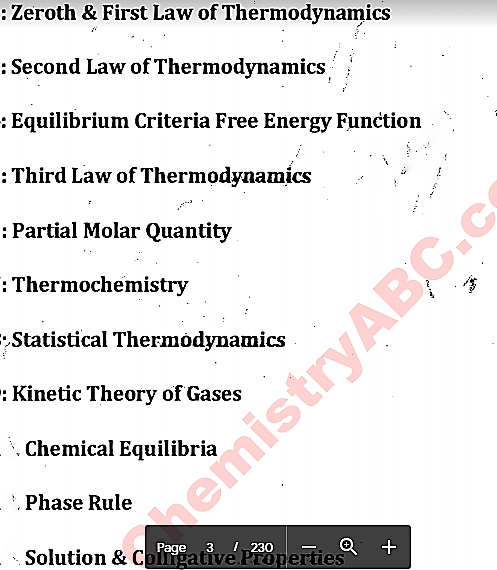
🖼️ 7. Classroom Notes Sample Page Preview
Below is a sample preview from the high-resolution scanned PDF notes:
❓ 8. Frequently Asked Questions (FAQs)
Yes. These classroom notes cover both classical thermodynamics (laws, Maxwell relations, chemical potential, non-ideal solutions) and statistical mechanics (ensembles, partition functions, residual entropy). Paired with previous year questions, it provides complete preparation.
In homonuclear diatomics like N2 or O2, a 180° rotation around the perpendicular axis leaves the molecule in an indistinguishable orientation. To avoid double-counting quantum microstates in phase space, the rotational partition function is divided by σ = 2.
Click the download button below. The link directs to an open Google Drive mirror where you can read online or download the 7.4 MB PDF file directly without registration.
Download Complete Thermodynamics Notes (PDF)
File Size: ~7.4 MB • Direct Google Drive High-Speed Link
📥 FREE DOWNLOAD THERMODYNAMICS PDFEducational Disclaimer: ChemistryABC.com provides free educational study materials and past notes strictly for self-study and competitive exam preparation. All trademarks and copyright ownership remain with their original authors and publishers. We encourage students to buy original published books from authorized sources.
For queries or DMCA removal requests, please email us at: [email protected]
2 Comments