

Chemical Kinetics is one of the highest-scoring and conceptually vital sections of Physical Chemistry in the CSIR-UGC NET Chemical Sciences and GATE Chemistry examinations. A structured set of concise revision notes enables aspirants to master rate laws, complex reaction mechanisms, and temperature-dependent kinetics with minimal revision time.
To support your preparation, we have compiled comprehensive, topper-recommended Chemical Kinetics Handwritten Notes in PDF format available for free download. These notes cover everything from fundamental integrated rate equations to advanced Part C topics like the Lindemann-Hinshelwood mechanism, transition state theory, and Michaelis-Menten enzyme kinetics.
CSIR NET Chemical Kinetics: Marks Weightage and Exam Trends
In CSIR NET Chemical Science, Chemical Kinetics consistently contributes between 15 to 25 marks across Part B and Part C:
| Exam Section | Typical Questions | Marks per Question | Focus Areas & Question Types |
|---|---|---|---|
| Part B (Core Basics) | 2 to 3 Questions | +2 Marks | Order of reactions, units of rate constant (k), Arrhenius activation energy, half-life relationships, simple collision theory. |
| Part C (Advanced Concepts) | 3 to 4 Questions | +4 Marks | Steady-State Approximation (SSA), chain reactions (H2 − Br2), enzyme kinetics (Lineweaver-Burk plots), kinetic salt effect, fast reaction relaxation methods. |
| Total Impact | 5 to 7 Questions | 16 to 22 Marks | High accuracy potential with mathematical derivations and graphical plots. |

Core Topics Covered in These Chemical Kinetics Notes
- Rate Equations & Order of Reaction: Zero, first, second, third, and nth-order integrated rate laws, half-life (t1/2) derivations, and methods to determine order (initial rate, half-life, differential method).
- Temperature Dependence of Reaction Rates: Arrhenius equation, activation energy (Ea), pre-exponential factor (A), temperature coefficient, and catalyzed versus uncatalyzed energy profiles.
- Theories of Reaction Rates: Classical Collision Theory, steric factor (P), Transition State Theory (Eyring equation), and thermodynamic activation parameters (ΔH‡, ΔS‡, ΔG‡).
- Complex Reaction Mechanisms: Opposing (reversible) reactions, consecutive (first-order sequential) reactions with rate-determining step analysis, and parallel (competing) pathways.
- Steady-State Approximation (SSA): Practical derivations for reactive intermediates, free-radical chain reactions (e.g., H2 + Br2 → 2HBr), and branching chain explosions.
- Unimolecular Reactions: Lindemann-Hinshelwood mechanism, high-pressure and low-pressure limiting kinetics, and Hinshelwood-RRKM modifications.
- Enzyme Kinetics: Derivation of the Michaelis-Menten equation, Vmax, Km significance, catalytic efficiency (kcat/Km), and competitive, non-competitive, and uncompetitive inhibition diagnostics via Lineweaver-Burk plots.
- Kinetic Isotope and Salt Effects: Primary and secondary kinetic isotope effects (KIE), and the Debye-Huckel primary and secondary salt effect on ionic reactions in solution: log10(k/k0) = 2A zA zB √I.
- Fast Reactions & Catalysis: Flash photolysis, flow methods, chemical relaxation methods (temperature-jump, pressure-jump relaxation times), and acid-base catalysis.
Summary Table: Integrated Rate Laws at a Glance
Quick formula reference for Part B and Part C numericals and linear graphical plots:
| Order (n) | Differential Rate Law | Integrated Rate Law | Half-Life (t1/2) | Units of k | Linear Plot (y vs x) |
|---|---|---|---|---|---|
| 0 | −d[A]/dt = k | [A]t = [A]0 − kt | t1/2 = [A]0 / 2k | mol·L−1·s−1 | [A] vs t (Slope: −k) |
| 1 | −d[A]/dt = k[A] | ln[A]t = ln[A]0 − kt | t1/2 = 0.693 / k | s−1 | ln[A] vs t (Slope: −k) |
| 2 | −d[A]/dt = k[A]2 | 1/[A]t = 1/[A]0 + kt | t1/2 = 1 / (k[A]0) | L·mol−1·s−1 | 1/[A] vs t (Slope: +k) |
| n (n ≠ 1) | −d[A]/dt = k[A]n | 1/[A]tn−1 − 1/[A]0n−1 = (n − 1)kt | t1/2 ∝ 1 / [A]0n−1 | (mol/L)1−n·s−1 | [A]1−n vs t |
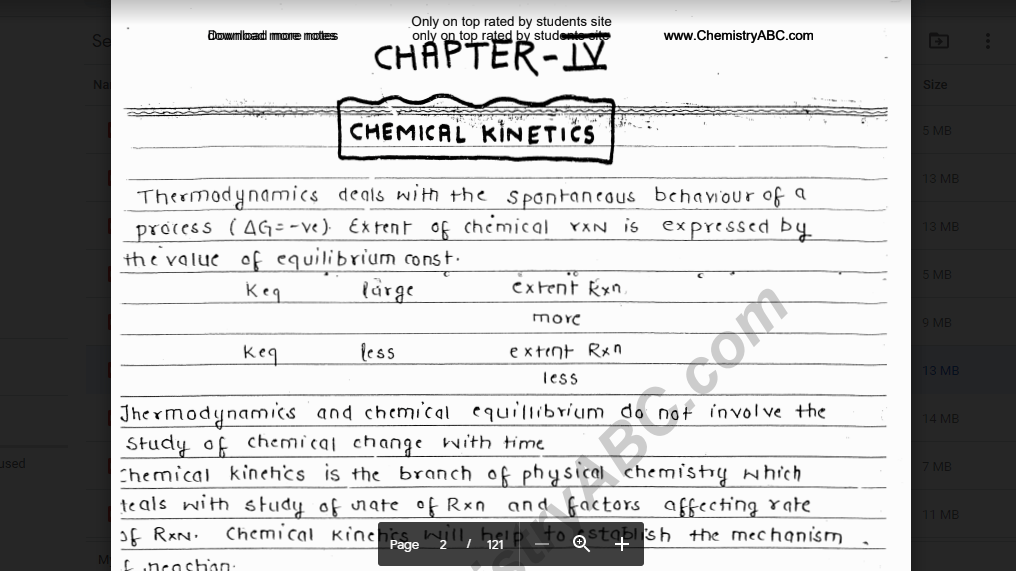
Download Chemical Kinetics Handwritten Notes (PDF)
Click the link below to access and download the complete high-resolution handwritten PDF directly to your device for offline study.
Explore Related Chemistry Study Materials
Enhance your CSIR NET & GATE preparation with our dedicated full study notes and interactive CBT mock tests:
Educational Fair Use Notice: ChemistryABC.com is dedicated to providing open educational resources for deserving students and competitive exam aspirants. We support academic authors, publications, and copyright holders. Readers are encouraged to purchase original standard textbooks (e.g., Laidler, Atkins, McQuarrie) from official distribution channels.
Frequently Asked Questions (FAQs)
What is the weightage of Chemical Kinetics in CSIR NET Chemical Science?
Chemical Kinetics typically accounts for 16 to 22 marks in the CSIR-UGC NET exam. Usually, 2 to 3 questions appear in Part B (basic integrated rate laws and activation energy) and 3 to 4 multi-concept problems appear in Part C (steady-state approximations, enzyme inhibition, and kinetic salt effects).
How does the Primary Kinetic Salt Effect influence reaction rates?
According to the Bronsted-Bjerrum equation, the rate of an ionic reaction depends on the ionic strength (I) of the solution: log10(k/k0) = 2A zA zB √I. If the reacting ions possess charges of the same sign (zA zB > 0), increasing ionic strength accelerates the rate. If they carry opposite charges (zA zB < 0), increasing ionic strength retards the reaction rate.
What are the best reference books for Chemical Kinetics for CSIR NET?
Standard authoritative texts include Chemical Kinetics by Keith J. Laidler, Physical Chemistry by Peter Atkins & Julio de Paula, and A Textbook of Physical Chemistry (Volume 5: Dynamics of Chemical Reactions) by K.L. Kapoor.
Chemical bond study material
Chemistry subject Boi class 11th
Handwritten nodes
we have more than one version of same notes in different headwritting. scroll on some pages and use search button.
Chemical kinetics study material.