
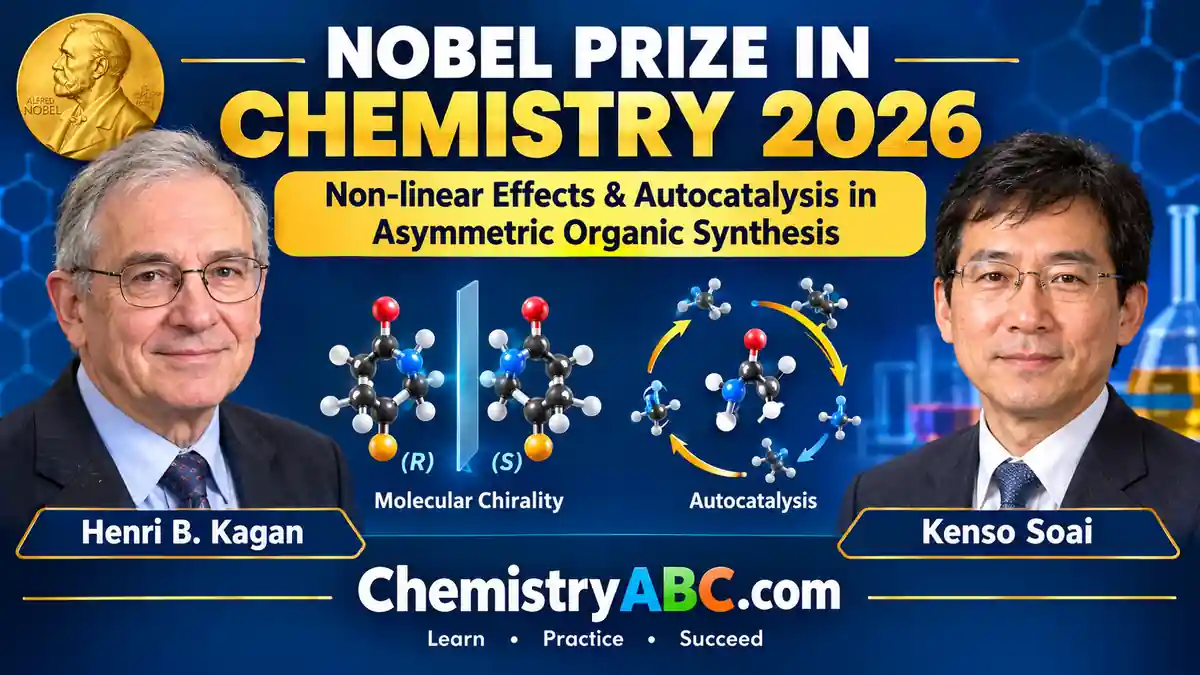
Nobel Prize in Chemistry 2026: Henri B. Kagan & Kenso Soai
The 2026 Nobel Prize in Chemistry has been awarded jointly to Henri B. Kagan (Université Paris-Saclay, France) and Kenso Soai (Tokyo University of Science, Japan) for the discovery of non-linear effects and autocatalysis in asymmetric organic synthesis—groundbreaking work that unlocked the origin of biological homochirality and transformed single-enantiomer drug design.
🏆 Explore the Nobel Discovery- 1. Official Citation & Laureates Overview
- 2. The Big Mystery: What is Biological Homochirality?
- 3. Henri B. Kagan: Discovery of Non-Linear Effects (+NLE / −NLE)
- 4. Kenso Soai: Asymmetric Autocatalysis & The Soai Reaction
- 5. Real-World Impact: Origin of Life & Chiral Drug Manufacturing
- 6. Key Takeaways for CSIR NET & GATE Chemical Sciences
- 7. Frequently Asked Questions (FAQs)
🏅 1. Official Citation & Laureates Overview
| Laureate | Affiliation | Primary Contribution | Prize Share |
|---|---|---|---|
| Henri B. Kagan | Université Paris-Saclay / CNRS, Orsay, France | Pioneering the discovery of Non-Linear Effects (NLE) in asymmetric catalysis; showing chiral amplification via dimeric/oligomeric catalyst complexes. | ½ Share |
| Kenso Soai (Soai Kensō) | Tokyo University of Science, Shinjuku, Tokyo, Japan | Discovery of Asymmetric Autocatalysis (The Soai Reaction); where a chiral product acts as a chiral catalyst for its own generation with dramatic amplification. | ½ Share |
🧩 2. The Big Mystery: What is Biological Homochirality?
Living organisms are strictly homochiral. Almost every essential biological building block exists in only one of two possible non-superimposable mirror-image forms (enantiomers):
- Amino Acids in Proteins: Virtually all natural amino acids are strictly of the L-configuration.
- Sugars in DNA/RNA: Ribose and deoxyribose backbones are strictly of the D-configuration.
In laboratory flasks, non-enzymatic chemical reactions from achiral precursors invariably generate an exact 50:50 racemic mixture of left- and right-handed molecules. For over a century, scientists asked: How did life on prebiotic Earth break this 50:50 symmetry and amplify an infinitesimally small initial chiral imbalance into complete, 100% homochirality? Kagan and Soai answered this fundamental puzzle.
🧪 3. Henri B. Kagan: Non-Linear Effects in Asymmetric Synthesis
Historically, chemists assumed a linear relationship: if a chiral catalyst had 20% enantiomeric excess (ee), the resulting reaction product would have at most 20% ee. Henri Kagan overturned this dogmatic assumption by discovering Non-Linear Effects (NLE).
Kagan demonstrated that a catalyst with very low optical purity (e.g., only 10% to 15% ee) can produce reaction products with exceptionally high optical purity (>90% ee)!
The Reservoir Mechanism: In reaction mixtures, chiral catalysts often aggregate into homochiral (e.g., (R,R) and (S,S)) and heterochiral (R,S) dimers or oligomers. If the heterochiral (R,S) dimer is catalytically inactive or precipitates out (acting as a “chiral reservoir” or sponge for the minority enantiomer), the remaining active monomer or homochiral dimer is dramatically enriched in the dominant enantiomer, yielding products with astonishingly high enantiomeric purity.
⚡ 4. Kenso Soai: Asymmetric Autocatalysis (The Soai Reaction)
In 1995, Japanese chemist Kenso Soai discovered what is widely recognized as one of the most astonishing reactions in all of chemistry: Asymmetric Autocatalysis with Self-Amplification.
Reaction of pyrimidine-5-carbaldehyde with diisopropylzinc [Zn(i-Pr)2] produces pyrimidyl alcohol. The resulting chiral pyrimidyl alcohol catalyzes its own formation!
- Exponential Chiral Multiplication: If a reaction starts with a tiny enantiomeric excess as low as 0.00005% ee (an almost undetectable difference of 100,000 versus 100,001 molecules), consecutive autocatalytic reaction cycles amplify the product enantiomeric excess to >99.5% ee!
- Triggered by Physical Chiral Triggers: Soai proved that this amplification can even be triggered by physical chiral influences—such as chiral crystals of quartz (SiO2), circularly polarized light (CPL), or isotopic chirality (compounds chiral purely due to 1H vs. 2H or 12C vs. 13C substitution).
🌍 5. Real-World Applications: Pharmaceuticals to Prebiotic Evolution
| Application Sector | Technological Transformation | Practical Significance |
|---|---|---|
| Pharmaceutical Drug Synthesis | Single-enantiomer active pharmaceutical ingredient (API) manufacturing | Eliminates toxic or inactive mirror enantiomers (e.g., thalidomide tragedy context), reducing cost and side effects. |
| Prebiotic Origin of Life (Abiogenesis) | Plausible mechanism for primordial homochirality | Provides experimental proof that cosmic or statistical fluctuations on early Earth could naturally trigger 100% biological homochirality. |
| Catalyst Economy & Green Chemistry | Elimination of expensive enantiopure chiral reagents | Allows chemists to use partially resolved, cheaper catalyst mixtures while still obtaining high-purity chiral products. |
📝 6. Key Takeaways for CSIR NET & GATE Chemical Sciences
Asymmetric catalysis and stereochemical amplification are recurring topics in CSIR NET Chemical Science Part C (4-mark analytical questions):
- Definition of Enantiomeric Excess: % ee = [ |(R) − (S)| / ((R) + (S)) ] × 100%.
- Linear vs. Non-Linear Correlation: In standard asymmetric induction, % eeproduct = % eecatalyst × ee0. In Kagan’s non-linear effect, deviation from linearity indicates catalytic active species with higher aggregation numbers (dimers, trimers).
- Unique Hallmark of Soai Reaction: It remains the only known chemical reaction that exhibits high asymmetric autocatalysis with substantial amplification of optical purity without needing an external chiral auxiliary.
❓ 7. Frequently Asked Questions (FAQs)
The 2026 Nobel Prize in Chemistry was awarded jointly to Henri B. Kagan (France) and Kenso Soai (Japan) for their discoveries of non-linear effects and asymmetric autocatalysis in organic synthesis.
The Soai reaction demonstrates asymmetric autocatalysis, where a chiral product acts as a chiral catalyst for its own formation, exponentially magnifying an extremely small initial enantiomeric imbalance (even <0.001% ee) to near-absolute enantiopurity (>99.5% ee).
Kagan’s positive non-linear effect (+NLE) allows pharmaceutical chemists to use partially enriched, cost-effective chiral catalysts (e.g., 20% to 30% ee) to produce optical drugs with over 90% enantiomeric purity, dramatically lowering production costs.