
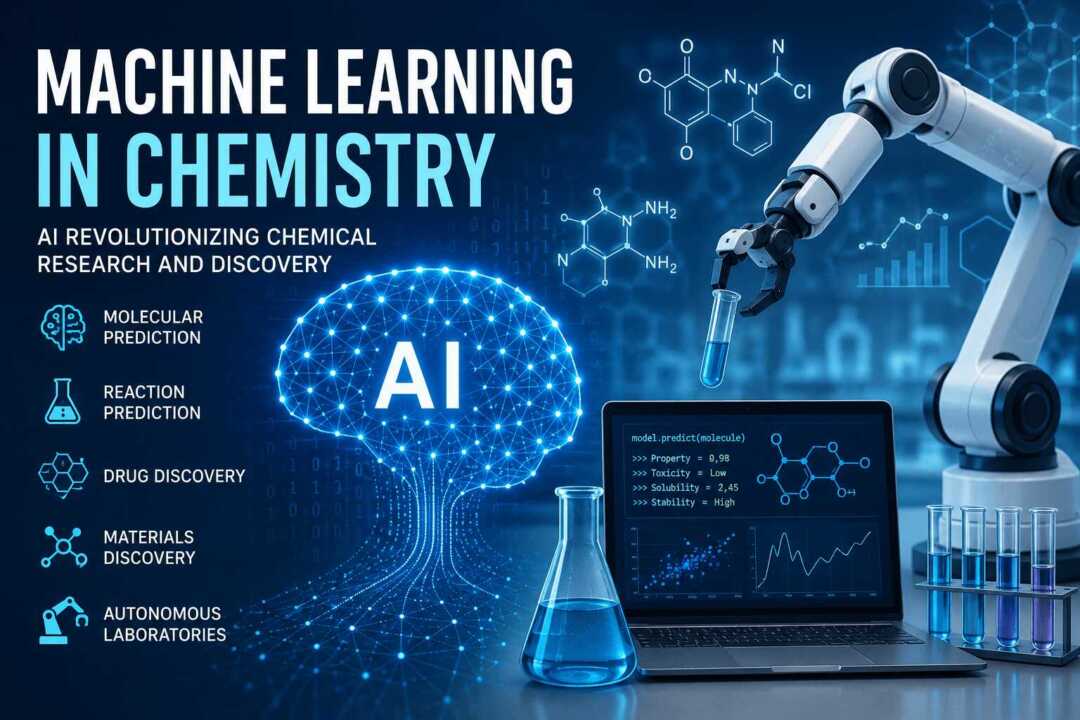
Machine Learning in Chemistry: How AI is Transforming Chemical Research in 2026
Artificial Intelligence (AI) has become one of the most influential technologies across scientific disciplines, and chemistry is no exception. Among AI technologies, machine learning in chemistry is revolutionizing how researchers discover new molecules, optimize chemical reactions, predict molecular properties, and accelerate scientific innovation.
Traditional chemical research often requires years of laboratory experiments, extensive trial-and-error, and significant financial investment. Today, machine learning models can analyze millions of chemical structures within minutes, helping scientists identify promising compounds before performing physical experiments.
In this article, we’ll explore how machine learning is changing chemistry, its major applications, advantages, challenges, and what the future holds for AI-powered chemical research.
What is Machine Learning in Chemistry?
Machine learning (ML) is a branch of artificial intelligence that enables computers to learn patterns from data and make predictions without being explicitly programmed for every task.
In chemistry, ML algorithms are trained using large datasets containing information such as:
- Molecular structures
- Chemical reactions
- Spectroscopic data
- Physical properties
- Biological activity
- Experimental conditions
After training, these models can accurately predict chemical behavior, reducing experimental time and improving research efficiency.
Why Machine Learning Matters in Chemistry
Modern chemistry generates enormous amounts of experimental and computational data every day.
Examples include:
- Millions of compounds in chemical databases
- High-throughput screening experiments
- Molecular simulations
- Quantum chemistry calculations
- Spectroscopic measurements
Analyzing such massive datasets manually is nearly impossible.
Machine learning helps scientists discover hidden relationships that humans may overlook, making research faster, cheaper, and more accurate.
Major Applications of Machine Learning in Chemistry
1. Drug Discovery
One of the largest applications of machine learning is pharmaceutical research.
ML models help scientists:
- Predict biological activity
- Identify drug candidates
- Estimate toxicity
- Optimize molecular structures
- Reduce clinical failure rates
This significantly shortens drug development timelines and reduces research costs.
2. Molecular Property Prediction
Machine learning predicts important molecular properties such as:
- Solubility
- Melting point
- Boiling point
- Toxicity
- pKa
- Partition coefficient (LogP)
- Stability
- Reactivity
Instead of performing expensive laboratory experiments, researchers can obtain reliable predictions within seconds.
3. Reaction Prediction
Chemical reaction prediction has become one of the most exciting AI applications.
Machine learning can predict:
- Reaction products
- Reaction yield
- Optimal catalysts
- Suitable solvents
- Best reaction conditions
This enables chemists to design experiments more efficiently.
4. Materials Discovery
Machine learning accelerates the discovery of advanced materials including:
- Battery materials
- Catalysts
- Solar cell materials
- Metal-organic frameworks (MOFs)
- Polymers
- Superconductors
Instead of synthesizing thousands of materials experimentally, researchers can screen millions virtually.
5. Quantum Chemistry
Quantum chemical calculations are computationally expensive.
Machine learning models can approximate:
- Molecular energies
- Electron density
- Potential energy surfaces
- Molecular orbitals
This reduces computational costs while maintaining impressive accuracy.
6. Spectroscopy Analysis
Machine learning assists in interpreting:
- NMR spectra
- IR spectra
- Raman spectra
- UV-Visible spectra
- Mass spectrometry
Automated spectral interpretation saves countless hours of manual analysis.
7. Autonomous Laboratories
One of the newest developments is the AI-driven autonomous laboratory.
These laboratories combine:
- Robotics
- Machine learning
- Automated synthesis
- Real-time analysis
The AI system performs experiments, analyzes results, designs new experiments, and continuously improves its predictions with minimal human intervention.
Machine Learning Algorithms Used in Chemistry
Several ML algorithms are widely used:
Supervised Learning
Used for:
- Property prediction
- Toxicity prediction
- Reaction yield estimation
Examples:
- Random Forest
- Support Vector Machine (SVM)
- Gradient Boosting
- Neural Networks
Unsupervised Learning
Useful for:
- Molecular clustering
- Chemical database analysis
- Pattern discovery
Methods include:
- K-Means Clustering
- Principal Component Analysis (PCA)
Deep Learning
Deep learning models excel at:
- Molecular image recognition
- Protein-ligand interactions
- Molecular generation
- Reaction prediction
Popular architectures include:
- Graph Neural Networks (GNNs)
- Convolutional Neural Networks (CNNs)
- Transformers
Machine Learning and Molecular Representations
Before AI can understand molecules, chemical structures must be converted into machine-readable formats.
Common molecular representations include:
- SMILES notation
- Molecular fingerprints
- Graph representations
- Molecular descriptors
- Coulomb matrices
Graph Neural Networks have become particularly successful because molecules naturally form graph structures.
Advantages of Machine Learning in Chemistry
Machine learning offers numerous benefits:
Faster Research
Predictions take seconds instead of weeks.
Lower Costs
Fewer laboratory experiments reduce research expenses.
Improved Accuracy
Modern AI models achieve remarkable predictive performance.
Accelerated Drug Discovery
Potential medicines can be identified much earlier.
Better Material Design
Researchers can discover high-performance materials more efficiently.
Sustainable Research
Machine learning minimizes waste by reducing unnecessary experiments, supporting greener laboratory practices.
Challenges of Machine Learning in Chemistry
Despite rapid progress, several challenges remain.
Data Quality
Machine learning is only as good as the data used for training.
Incomplete or incorrect datasets reduce model accuracy.
Limited Experimental Data
Some specialized research areas have very small datasets, making model training difficult.
Interpretability
Deep learning models often behave like “black boxes,” making it difficult to explain why they make certain predictions.
Researchers are actively developing explainable AI (XAI) methods to improve transparency.
Generalization
Models trained on one dataset may not perform well for completely new chemical systems.
Machine Learning in Green Chemistry
Machine learning is also supporting sustainable chemistry by helping researchers:
- Reduce hazardous chemicals
- Optimize reaction conditions
- Minimize energy consumption
- Improve catalyst efficiency
- Predict environmentally friendly solvents
- Lower chemical waste
This contributes to cleaner and more sustainable industrial processes.
Future of Machine Learning in Chemistry
The next decade will likely witness even greater integration of AI into chemical research.
Emerging trends include:
- AI-designed molecules
- Fully autonomous research laboratories
- AI-assisted organic synthesis
- Quantum machine learning
- Digital twins for chemical manufacturing
- Personalized drug development
- AI-driven catalyst discovery
Large language models and foundation models trained on chemical data are expected to become powerful assistants for researchers, enabling faster literature analysis, hypothesis generation, and experimental planning.
Frequently Asked Questions (FAQs)
Is machine learning replacing chemists?
No. Machine learning complements chemists by automating repetitive tasks and providing predictions. Human expertise remains essential for designing experiments, interpreting results, and making scientific decisions.
Which programming language is most popular for machine learning in chemistry?
Python is the most widely used language due to its rich ecosystem of scientific and machine learning libraries, including TensorFlow, PyTorch, scikit-learn, and RDKit.
What datasets are commonly used?
Popular chemical datasets include:
- PubChem
- ChEMBL
- QM9
- ZINC Database
- Protein Data Bank (PDB)
Can beginners learn machine learning for chemistry?
Yes. A basic understanding of chemistry, Python programming, statistics, and linear algebra provides a strong foundation for learning machine learning in chemical research.
Conclusion
Machine learning in chemistry is reshaping the way scientific discoveries are made. From predicting molecular properties and accelerating drug discovery to enabling autonomous laboratories and advancing sustainable chemistry, AI is becoming an indispensable tool for modern chemists.
As datasets grow larger and algorithms become more sophisticated, machine learning will continue to accelerate innovation across pharmaceuticals, materials science, environmental chemistry, and industrial manufacturing. Rather than replacing chemists, it empowers them to make faster, smarter, and more impactful discoveries.
Researchers, students, and industry professionals who embrace machine learning today will be well-positioned to lead the next generation of chemical innovation.