
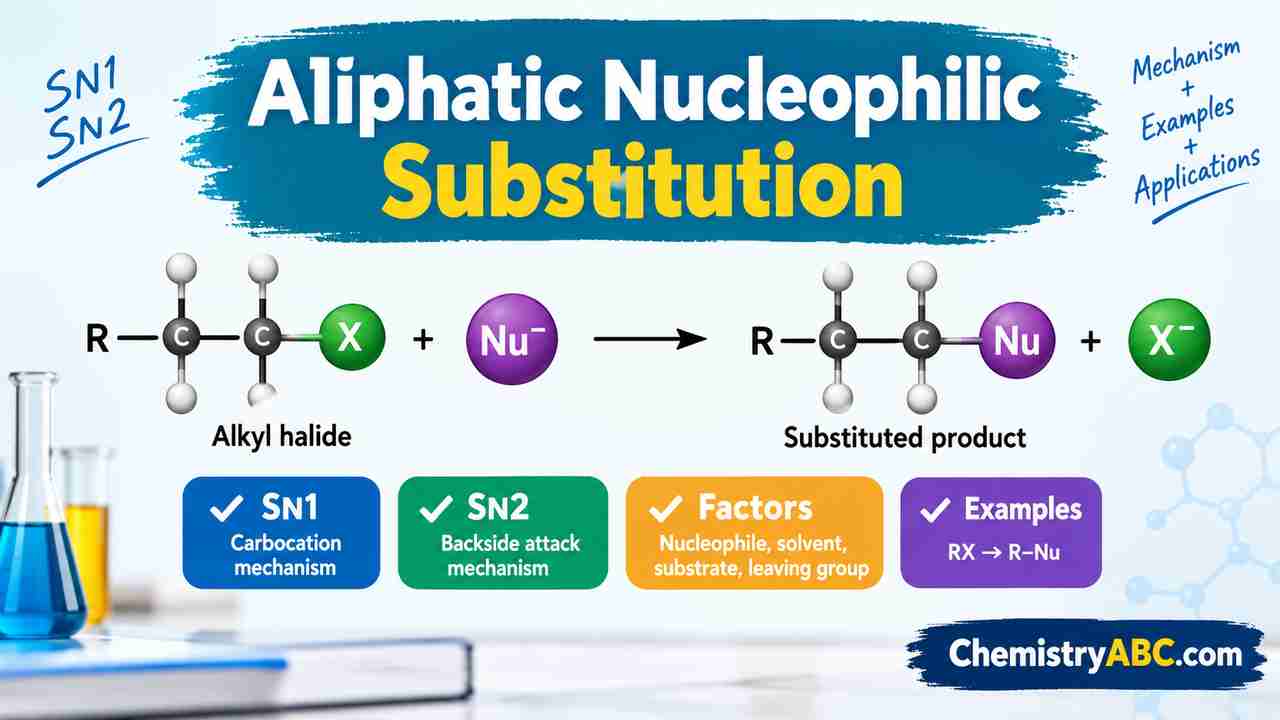
Aliphatic Nucleophilic Substitution: Mechanisms, NGP & Non-Classical Ions
Exhaustive master study notes on SN1, SN2, SNi, and SET pathways, Ion-Pair intermediates (Winstein Spectrum), Neighboring Group Participation (anchimeric assistance by lone pairs, π, and σ bonds), the 2-Norbornyl Cation controversy, and allylic SN2′ substitutions.
- 1. SN1 vs. SN2 Mechanistic Continuum
- 2. Winstein Ion-Pair Spectrum (Intimate vs. Solvent-Separated)
- 3. Neighboring Group Participation (Anchimeric Assistance)
- 4. Vector Diagram: NGP via Episulfonium & Phenonium Ions (SVG)
- 5. The 2-Norbornyl Cation Controversy (Winstein vs. Brown)
- 6. Internal Return: SNi Mechanism with SOCl2
- 7. Vector Diagram: SNi vs. SN2 Stereochemical Divergence (SVG)
- 8. Allylic Nucleophilic Substitution: SN2 vs. SN2′
- 9. Ambident Nucleophiles & Kornblum’s Rule
- 10. High-Yield Exam Summary (CSIR NET & GATE)
- 11. Support ChemistryABC & Helpline Community
- 12. Frequently Asked Questions (FAQ)
Nucleophilic substitution at an sp3-hybridized aliphatic carbon is fundamental to synthetic organic chemistry. In MSCCH-502 (Unit 6) and competitive examinations (CSIR NET, GATE Chemistry, SET), study moves beyond elementary generalizations into the kinetic-mechanistic continuum: multi-stage ion-pair equilibria, anchimeric rate accelerations exceeding 1011 via intramolecular participation, and non-classical delocalized carbocation intermediates.
Nucleophilic substitution does not occur as two mutually exclusive extremes (pure SN1 vs. pure SN2). Instead, it exists along a continuous spectrum governed by the Winstein ion-pair model. The degree of carbocation freedom, solvent dielectric constant, nucleophile nucleophilicity, and internal neighboring-group assistance dictate whether a reaction yields clean inversion, complete racemization, or net retention of configuration.
1. The Winstein Ion-Pair Spectrum
Saul Winstein established that solvolytic SN1 reactions do not directly liberate completely free, symmetrically solvated carbocations in a single dissociation step. Dissociation proceeds through a cascade of progressively separated ion-pair stages:
Covalent Substrate • Intimate (Contact) Ion Pair • Solvent-Separated Ion Pair • Dissociated (Free) Ions
- Intimate (Contact) Ion Pair [ R+ X− ]: The leaving group X− has cleaved its covalent bond but remains directly coordinated to the carbocation face without intervening solvent molecules. Nucleophilic attack at this stage occurs exclusively from the rear, yielding net inversion of configuration even under apparent first-order kinetics!
- Solvent-Separated Ion Pair (SSIP) [ R+ || X− ]: One or more solvent molecules intervene between R+ and X−. The leaving group still loosely shields the front face, yielding a mixture of inversion and racemization.
- Free Carbocation [ R+ + X− ]: Symmetrically solvated planar carbocation (D3h symmetry). Attack by nucleophile from either face occurs with equal probability, giving complete (100%) racemization.
- Common-Ion vs. Special Salt Effect: Addition of salts with a common anion (e.g., LiX) represses the dissociation of free ions (the common-ion effect). Addition of non-common inert perchlorate salts (LiClO4) intercepts the solvent-separated ion pair, preventing internal return and causing a dramatic acceleration in solvolysis rates (the special salt effect).
2. Neighboring Group Participation (Anchimeric Assistance)
Neighboring Group Participation (NGP) occurs when an atom or group with non-bonding electrons, a π-system, or a σ-bond assists in the departure of the leaving group via an intramolecular attack. This imparts two hallmark experimental features:
- Enormous Rate Acceleration: Intramolecular displacement to form a transient 3-membered cyclic intermediate is kinetically favored (ΔS‡ is much less negative than intermolecular attack). The factor by which the rate increases is termed the anchimeric assistance factor.
- Complete Retention of Configuration: The reaction involves two successive back-side Walden inversions:
- First Step: The internal neighboring group attacks the reacting carbon from the rear, ejecting the leaving group with inversion to form a cyclic onium ion.
- Second Step: The external nucleophile attacks the cyclic intermediate from the rear, opening the ring with a second inversion.
- Net Stereochemical Outcome: Inversion × Inversion = 100% Retention of Configuration!
| Participating Group | Intermediate Formed | Relative Rate vs. Reference | Classic Example |
|---|---|---|---|
| Sulfur Lone Pair (−SR) | Thiiranium (episulfonium) ion | 103 to 104 faster | Sulfur mustard [ (ClCH2CH2)2S ] hydrolysis |
| Nitrogen Lone Pair (−NR2) | Aziridinium ion | 102 to 103 faster | Nitrogen mustard antitumor agents |
| Aromatic Ring (π-electrons) | Bridged Phenonium ion | 50 to 500 faster | threo-3-Phenyl-2-butyl tosylate acetolysis |
| Alkene Double Bond (π) | Bridged 7-norbornenyl cation | 1011 faster! | anti-7-Norbornenyl tosylate solvolysis |
| Carbon-Carbon σ-Bond | Delocalized non-classical ion | 350 faster (exo/endo) | exo-2-Norbornyl brosylate solvolysis |
3. Vector Mechanism: Neighboring Group Participation (NGP)
Below is the detailed reaction coordinate diagram illustrating intramolecular participation by non-bonding sulfur electrons (forming a 3-membered episulfonium ion) and aromatic π-electrons (forming a bridged phenonium ion):
4. The Classical vs. Non-Classical Controversy (2-Norbornyl Cation)
One of the most fierce intellectual debates in 20th-century physical organic chemistry took place between Saul Winstein (UCLA) and Nobel laureate Herbert C. Brown (Purdue University):
- Winstein’s Non-Classical Proposal: The 2-norbornyl cation is a single, symmetrical, bridged species containing a 3-center-2-electron (3c-2e) σ-bond delocalized across C1, C2, and C6. The bridging σ-bond provides anchimeric assistance from the back of C2, explaining why exo-leaving groups displace 350× faster than endo-leaving groups. The plane of symmetry renders the bridged cation achiral, resulting in complete racemization.
- H.C. Brown’s Classical Proposal: Brown argued that the species is merely a pair of rapidly equilibrating classical, localized carbocations (toggling between C1 and C2 via a fast 1,2-Wagner-Meerwein shift) whose interconversion barrier is too small to freeze on the NMR timescale. He attributed the exo-rate advantage to steric hindrance of endo-attack by endo-hydrogens at C5 and C6.
- The Definitive Resolution (Olah and 2013 Crystal Structure):
- George Olah (Nobel Prize 1994): Observed the 2-norbornyl cation in SbF5−SO2ClF (magic acid / superacid) at −159 °C. 13C NMR and ESCA (core electron binding energy) confirmed a single symmetrical energy minimum rather than two equilibrating minima.
- Ingo Krossing et al. (Science, 2013): Successfully grew single crystals of [C7H11]+ [Al2Br7]− at 40 K. X-ray diffraction unequivocally proved a pentacoordinate bridged carbon with a C1–C6 bond distance of 1.74 Å, officially confirming the non-classical bridged structure!
5. The SNi Mechanism vs. SN2 Inversion (SOCl2)
The stereochemical outcome of reacting chiral secondary alcohols with thionyl chloride (SOCl2) depends critically on solvent coordination and the presence of basic additives:
6. Allylic Nucleophilic Substitution: SN2 vs. SN2′
Allylic systems (R−CH=CH−CH2−X) contain a π-bond conjugated with the reaction center, leading to enhanced reactivity toward both SN1 and SN2 substitutions. Furthermore, nucleophiles can attack the conjugated framework at two distinct sites:
- Normal SN2 Attack (α-Attack): The nucleophile directly attacks the α-carbon bearing the leaving group, displacing X− without migration of the double bond.
- Abnormal SN2′ Substitution (γ-Attack): When the α-carbon is sterically hindered (e.g., secondary or tertiary allylic halide), the nucleophile attacks the unhindered γ-carbon. The π-electrons shift to form a new double bond between Cα and Cβ, simultaneously expelling the leaving group:Nu:− + Cγ=Cβ−Cα−X → Nu−Cγ−Cβ=Cα + X−
- Stereochemistry of SN2′: Depending on the conformation and whether the nucleophile coordinates to the leaving group prior to attack, the SN2′ process can occur with syn or anti stereospecificity. With uncharged nucleophiles or cyclic substrates, attack is predominantly syn (nucleophile enters from the same face as the departing leaving group).
7. Ambident Nucleophiles and Ambident Substrates
An ambident nucleophile possesses two or more nucleophilic atoms of different electronegativity that can compete for attack on an electrophilic center. Regioselectivity is governed by Kornblum’s Rule and Pearson’s HSAB (Hard and Soft Acids and Bases) principle:
| Ambident Nucleophile | Reagent Used | Attacking Atom | Major Product Formed |
|---|---|---|---|
| Cyanide Ion (CN−) | KCN or NaCN (Ionic) | Carbon (Soft nucleophilic site) | Alkyl Cyanide (Nitrile: R−CN) |
| Cyanide Ion (CN−) | AgCN (Covalent coordination) | Nitrogen (C is blocked by Ag) | Alkyl Isocyanide (Isonitrile: R−NC) |
| Nitrite Ion (NO2−) | KNO2 or NaNO2 (Ionic) | Oxygen (High charge density) | Alkyl Nitrite (R−O−N=O) |
| Nitrite Ion (NO2−) | AgNO2 (Covalent coordination) | Nitrogen (Electrophilic carbocation) | Nitroalkane (R−NO2) |
High-Yield Exam Points for CSIR NET & GATE
- Winstein Special Salt Effect: LiClO4 increases the rate of solvolysis by intercepting solvent-separated ion pairs (SSIP), suppressing internal return to the covalent state.
- In NGP by −SR, −NR2, and halogens, the net stereochemical outcome is 100% retention of configuration via two successive Walden inversions.
- In the reaction of chiral alcohols with SOCl2, retention occurs in dioxane or ether via the cyclic SNi mechanism, whereas inversion occurs in the presence of pyridine via an intermolecular SN2 back-side attack.
- anti-7-Norbornenyl tosylate solvolyzes 1011 times faster than 7-norbornyl tosylate due to participation of the homoconjugated C2=C3 π-bond.
- The 2-norbornyl cation is a true non-classical ion containing a symmetrical 3-center-2-electron C1–C6–C2 delocalized σ-bond, proven conclusively by NMR spectroscopy and 2013 X-ray crystallography.
Support ChemistryABC & Student Mentorship
Help us keep educational study materials 100% free for all students • Direct Mentor Guidance
ChemistryABC provides free master study notes, previous year question papers, and CBT mock tests. If our educational materials have helped you in your M.Sc. or competitive exam preparation, consider supporting our mission via UPI:
Frequently Asked Questions (FAQ)
The primary stereochemical proof is complete retention of configuration. The reaction proceeds through two consecutive back-side attacks: first an intramolecular attack by the neighboring group to form a cyclic intermediate (inversion 1), followed by an intermolecular attack by the nucleophile (inversion 2), yielding net overall retention.
Pyridine neutralizes the HCl produced to form pyridinium chloride, generating free, nucleophilic chloride ions (Cl−). Instead of the internal collapse of the chlorosulfite ester (SNi mechanism, which gives retention), the free chloride ion attacks the alkyl chlorosulfite from the back side via an SN2 displacement, resulting in inversion of configuration.
A classical carbocation has its positive charge localized predominantly on a single trivalent carbon atom with a vacant 2p orbital. A non-classical carbocation contains delocalized sigma-electrons participating in a 3-center-2-electron (3c-2e) bond, forming a bridged structure with pentacoordinate carbon atoms (e.g., the 2-norbornyl cation).