
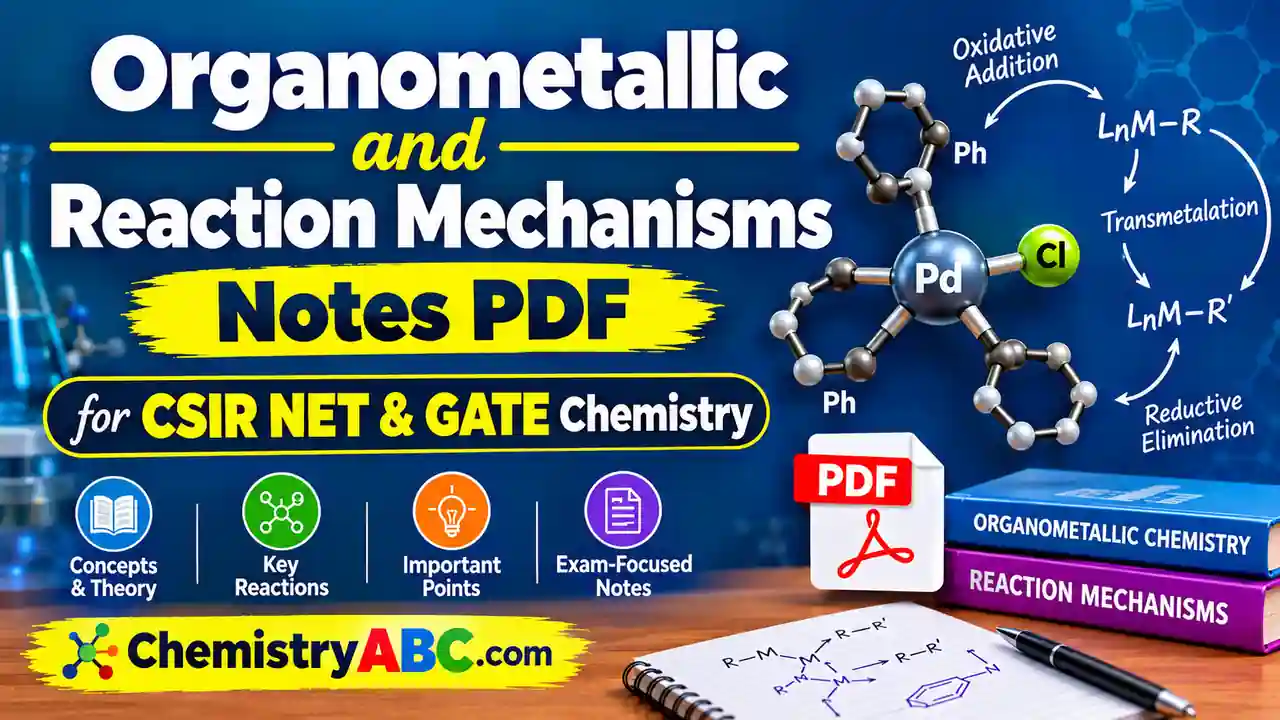
Organometallics and Reaction Mechanisms Notes PDF for CSIR NET & GATE
Complete, exam-oriented study notes covering Organometallic principles, fundamental elemental reaction steps, industrial homogeneous catalytic cycles, and coordination substitution mechanisms for CSIR UGC NET, GATE, BARC, and TIFR.
📥 Download Organometallics & Reaction Mechanisms PDF
Access the complete handwritten study notes directly via Google Drive:
Clean PDF • High-Resolution Scans • English / Handwritten
📌 Why Organometallics & Reaction Mechanisms Matter
In CSIR UGC NET Chemical Sciences and GATE Chemistry, Organometallics and Inorganic Reaction Mechanisms collectively contribute 30 to 45 marks every year. Mastering electron counting, elementary reaction pathways, and stereochemical outcomes in substitution reactions is essential for clearing the JRF cut-off.
- Predictable Scoring: Questions on 18-electron counting, Wade-Mingos cluster rules, and trans-effect follow fixed, systematic rules.
- Combined Spectroscopy: Frequent pairing of metal carbonyl νCO IR shifts with 1H/13C/31P NMR in Part C (4 marks).
- Industrial Applications: Catalytic cycles like Wilkinson’s hydrogenation, Monsanto acetic acid process, and Hydroformylation are recurring exam staples.
🔬 Core Topics Covered in These Notes
1. Organometallic Principles & Bonding
- 18-Electron Rule (EAN): Neutral (covalent) and ionic counting methods for mononuclear and polynuclear carbonyl complexes.
- Total Valence Electron (TVE) & Metal-Metal Bonds: Calculating M−M bonds using B = (18n − TVE) / 2 and predicting terminal vs. bridging carbonyl structures.
- Synergic Bonding in Metal Carbonyls: σ-donation from CO HOMO to metal d-orbitals and π-backdonation from metal d-orbitals into CO LUMO (π*). Influence of metal oxidation state on C−O stretching frequencies (νCO in cm−1).
- Metal Carbenes & Carbynes: Fischer carbenes (singlet carbene, electrophilic, low oxidation state, π-donor ligands) vs. Schrock carbenes (triplet carbene, nucleophilic, high oxidation state, alkyl ligands).
- Wade’s Rules (PSEPT): Polyhedral skeletal electron pairs calculation for boranes, heteroboranes, and transition metal clusters: Closo (n + 1), Nido (n + 2), Arachno (n + 3), and Hypho (n + 4).
2. Elementary Organometallic Reaction Steps
- Oxidative Addition (OA): Formal increase in coordination number by 2, oxidation state by +2, and electron count by +2. Stereochemical outcomes for polar (inversion via SN2) vs. non-polar (cis addition) substrates.
- Reductive Elimination (RE): Microscopic reverse of OA; requires cis-disposed leaving groups; promoted by bulky, π-acceptor ligands and high oxidation states.
- Migratory Insertion: 1,1-insertion (CO insertion into M−alkyl bonds via alkyl migration) and 1,2-insertion (alkene/alkyne insertion into M−H bonds).
- β-Hydride Elimination: Requires a syn-coplanar M−C−C−H geometry, vacant coordination site on the metal, and β-hydrogen atoms.
3. Industrial Homogeneous Catalysis
- Wilkinson’s Hydrogenation: [RhCl(PPh3)3] mechanism, phosphine dissociation, oxidative addition of H2, and rate-determining alkene insertion.
- Monsanto & Cativa Acetic Acid Processes: Rhodium vs. Iridium catalytic cycles for methanol carbonylation; identification of rate-determining oxidative addition step of CH3I.
- Hydroformylation (Oxo Process): Synthesis of linear and branched aldehydes from alkenes using HCo(CO)4 and Rh-phosphine catalysts.
- Wacker Oxidation: Conversion of ethylene to acetaldehyde using PdCl2 / CuCl2 catalysts in aqueous media.
- Olefin Metathesis: Chauvin mechanism, Grubbs (1st, 2nd, and 3rd generation) and Schrock carbene catalysts.
4. Coordination Reaction Mechanisms
- Substitution in Octahedral Complexes: Dissociative (D, Id) vs. Associative (A, Ia) pathways; conjugate base mechanism (SN1CB) in amine complexes.
- Substitution in Square Planar Complexes: Associative pathways involving 5-coordinate trigonal bipyramidal intermediates; kinetic trans-effect vs. thermodynamic trans-influence series:
CN− > CO > NO > C2H4 > PR3 > H− > CH3− > I− > Br− > Cl− > NH3 > OH− > H2O - Redox Reactions: Outer-sphere electron transfer (Marcus theory, Frank-Condon principle) vs. Inner-sphere electron transfer (bridging ligand criteria, lead-in and precursor complex formation).
📊 Examination Mark Weightage
Estimated distribution of questions across recent national competitive exams:
| Examination | Section | Typical Questions | Total Marks |
|---|---|---|---|
| CSIR UGC NET | Part B (Core MCQs, +2 / −0.5) | 3 – 5 Questions | 6 – 10 Marks |
| CSIR UGC NET | Part C (Analytical, +4 / −1.0) | 6 – 9 Questions | 24 – 36 Marks |
| GATE Chemistry | 1-Mark & 2-Mark MCQs / NATs | 6 – 8 Questions | 10 – 14 Marks |
| BARC / TIFR | Objective Chemistry Questions | 5 – 7 Questions | 15 – 21 Marks |
🎯 Recommended Topper Revision Strategy
- Daily Electron Counting Drills: Practice 18-electron calculations on polyhedral metal carbonyls, nitrosyls, and ferrocene derivatives until instantaneous.
- Trace Every Step of Catalytic Cycles: Memorize the oxidation state changes, electron count fluctuations, and coordination numbers for each intermediate in Wilkinson, Monsanto, and Wacker processes.
- Solve 10 Years of Previous Year Questions: Re-solve all Part C questions on substitution kinetics and cluster geometry at least 3 times.
❓ Frequently Asked Questions (FAQ)
Click the prominent green “Download Handwritten Notes” button above. It links directly to the secure Google Drive PDF file for online reading or offline saving.
Yes. These notes detail advanced concepts tested in Part C, including Wade-Mingos rules, isolobal analogies, trans-influence series, oxidative addition kinetics, and combined IR/NMR spectroscopy problems.
Recommended reference books include The Organometallic Chemistry of the Transition Metals by Robert H. Crabtree and Inorganic Chemistry by Huheey, Keiter & Keiter.