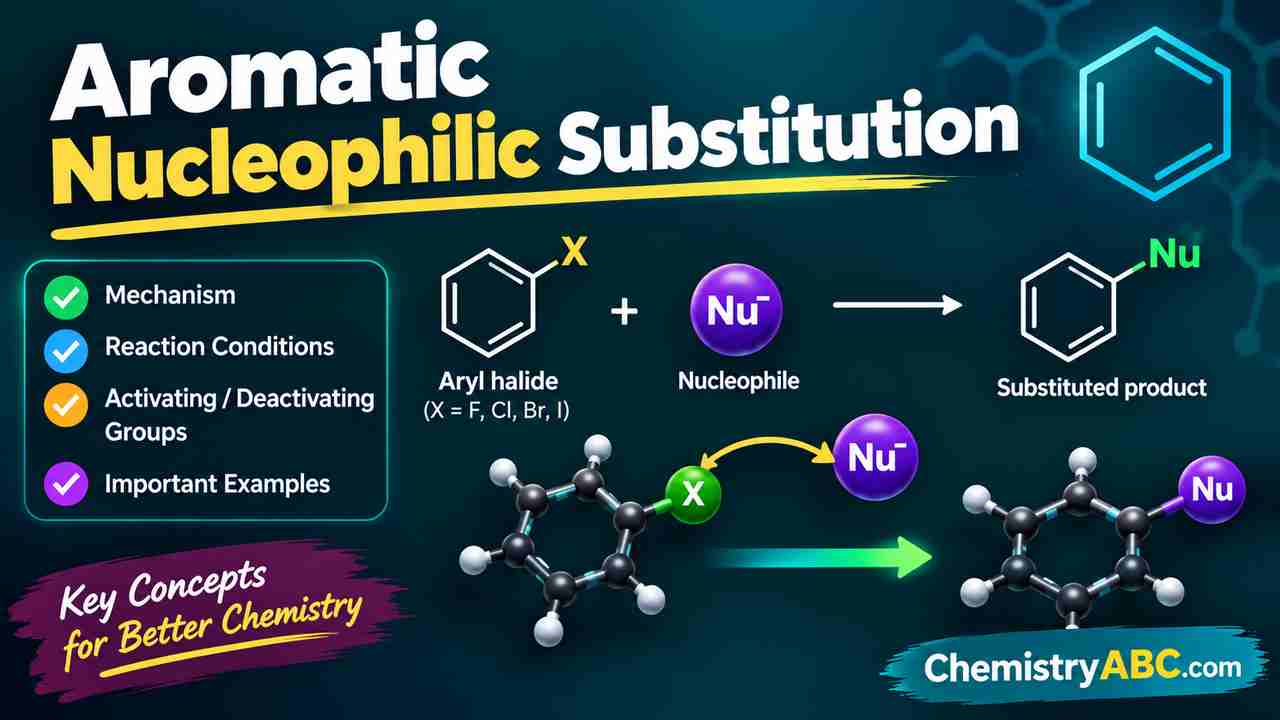
Aromatic Nucleophilic Substitution: SNAr, Benzyne, SRN1 & SN1 Mechanisms
Exhaustive master study notes on the Addition-Elimination pathway (SNAr via Meisenheimer σ-complexes), the Fluorine Leaving-Group Paradox, the Elimination-Addition (Benzyne) mechanism with Roberts’ 14C isotopic proof, SRN1 radical-chain processes, Arenediazonium substitutions, and Smiles / von Richter rearrangements.
- 1. Overview: The Four Mechanistic Pathways
- 2. SNAr: Addition-Elimination Mechanism
- 3. The Fluorine Paradox: Why F >> Cl ≈ Br ≈ I
- 4. Vector Diagram: SNAr via Meisenheimer Complex (SVG)
- 5. Benzyne Mechanism: Elimination-Addition
- 6. Vector Diagram: Benzyne & 14C Cine-Substitution (SVG)
- 7. Regioselectivity in Substituted Benzynes
- 8. SRN1: Radical-Nucleophilic Chain Substitution
- 9. Diazonium Salt Substitutions (Aryl Cation SN1)
- 10. Smiles & von Richter Rearrangements
- 11. High-Yield Comparative Exam Table (NET & GATE)
- 12. Support ChemistryABC & Helpline Community
- 13. Frequently Asked Questions (FAQ)
Unlike aliphatic halides, unactivated aryl halides are exceptionally inert toward classical SN2 substitution due to three fundamental physical barriers: partial double-bond character resulting from resonance donation of the halogen lone pair into the aromatic ring, sp2-hybridization of the aryl carbon (holding electrons closer to the nucleus and strengthening the C−X bond), and steric / electrostatic shielding preventing back-side nucleophilic approach through the aromatic π-cloud. Consequently, nucleophilic aromatic substitutions proceed via specialized alternative pathways.
Aromatic nucleophilic substitution operates through four distinct mechanisms: SNAr (activated by strong ortho/para electron-withdrawing groups via Meisenheimer σ-complexes), Elimination-Addition (unactivated haloarenes reacting with extremely strong bases via Benzyne intermediates), SRN1 (electron-transfer radical chain processes initiated photochemically or chemically), and SN1 (unimolecular loss of N2 from arenediazonium salts yielding fleeting aryl cations).
1. The SNAr (Addition-Elimination) Mechanism
When an aryl halide bears powerful electron-withdrawing substituents (such as −NO2, −CN, −SO2R, or −CF3) positioned ortho or para to the leaving group, substitution proceeds smoothly via the two-step Addition-Elimination (SNAr) sequence:
- Step 1 (Addition – Rate-Determining Step): The nucleophile attacks the ipso carbon (bearing the halogen), converting the planar sp2 aromatic carbon into an sp3-hybridized tetrahedral intermediate. This breaks aromaticity and generates a resonance-stabilized cyclohexadienyl anion called a Meisenheimer complex (σ-complex).
- Step 2 (Elimination – Fast Step): The Meisenheimer complex re-aromatizes via expulsion of the halide leaving group (X−), restoring the fully conjugated 6π aromatic sextet.
Why are Ortho and Para Orientations Essential?
Resonance structures show that the developing negative charge in the Meisenheimer intermediate is delocalized exclusively onto the ortho and para carbons of the ring. When an electron-withdrawing group like −NO2 is located ortho or para, the negative charge is accommodated directly onto the electronegative oxygen atoms of the nitro group via an exceptionally stable quinoid resonance contributor:
In contrast, when the nitro group is in the meta position, the negative charge resides on ring carbons adjacent to the nitro carbon but never directly on the nitro-bearing carbon itself. Hence, meta-nitrohalobenzenes react at rates only marginally faster than chlorobenzene.
2. The Fluorine Paradox in SNAr: Why F >> Cl ≈ Br ≈ I
In aliphatic SN2 substitutions, the leaving group order strictly follows carbon-halogen bond strength: I− > Br− > Cl− >> F− (Fluoride is the worst leaving group). However, in the SNAr mechanism, fluorine is by far the fastest leaving group:
Ar−F (3,300) >> Ar−Cl (1.0) ≈ Ar−Br (0.8) ≈ Ar−I (0.4)
Kinetic and Physical Explanation:
- Step 1 is Rate-Determining: Cleavage of the carbon-halogen bond occurs during the second, fast step (k2 >> k−1). Because C−X bond breaking does not occur in the rate-determining transition state, bond strength plays no role in determining reaction velocity!
- Strongest Electronegativity: Fluorine has the highest Pauling electronegativity (4.0). Its powerful inductive electron-withdrawing effect (−I) imparts the largest partial positive charge (δ+) on the ipso carbon, drastically accelerating nucleophilic attack (k1) and stabilizing the developing negative charge in the first transition state.
3. Vector Mechanism: The SNAr Addition-Elimination Pathway
The vector diagram below illustrates nucleophilic addition of Nu− to an activated haloarene, formation of the resonance-stabilized Meisenheimer complex, and subsequent loss of the halide leaving group:
4. The Benzyne (Elimination-Addition) Mechanism
When unactivated aryl halides (such as chlorobenzene) are treated with exceptionally strong bases (such as sodium amide, NaNH2, in liquid ammonia at −33 °C), substitution occurs via an Elimination-Addition mechanism involving a highly reactive, neutral intermediate called benzyne (dehydrobenzene / 1,2-aryne):
- Step 1 (Elimination – Benzyne Formation): The strong amide base (NH2−) abstracts an ortho proton relative to the halogen, and the resulting carbanion expels Cl− via an E2 (or E1cB) elimination to generate a transient benzyne ring.
- Nature of the Benzyne Triple Bond: The formal triple bond consists of the standard aromatic delocalized 6π electron system plus a second, localized π-bond formed by lateral overlap of two adjacent sp2 hybrid orbitals lying in the plane of the ring (orthogonal to the aromatic π-cloud). Because the sp2 orbitals cannot achieve parallel coplanarity without extreme ring strain, overlap is weak, making benzyne exceptionally reactive and electrophilic.
- Step 2 (Addition – Product Formation): The nucleophile (NH2−) can attack either carbon of the triple bond, followed by proton transfer from liquid NH3, yielding both direct and cine-substitution products.
5. Vector Mechanism: Benzyne Intermediate & 14C Labelling Proof
John D. Roberts provided the classic experimental proof of the benzyne mechanism using [1-14C]chlorobenzene. As illustrated below, equal attack at C-1 and C-2 produces an exact 50:50 mixture of [1-14C]aniline (direct substitution) and [2-14C]aniline (cine-substitution):
6. Regioselectivity in Substituted Benzynes
When an aryne possesses a substituent, nucleophilic addition to the two carbons of the triple bond is no longer equal. Regiochemistry is governed primarily by the inductive effect of the substituent on the developing carbanionic center:
- Substituents with an Inductive Electron-Withdrawing (−I) Effect (−OMe, −CF3, −Cl):
- In 3-methoxybenzyne (generated from o-chloroanisole), addition of NH2− occurs predominantly at C-2 (meta position).
- Why? Attack at C-2 places the negative charge on C-1 (ortho to the methoxy group). The strong inductive electron-withdrawing effect of the oxygen atom stabilizes the carbanion directly. Consequently, m-anisidine is formed as the major product (>95%), while o-anisidine is formed in trace amounts!
- Substituents with an Inductive Electron-Donating (+I) Effect (−CH3):
- In 4-methylbenzyne (generated from p-chlorotoluene), the methyl group weakly destabilizes negative charge at the closer carbon. Attack occurs almost equally at C-3 and C-4, yielding an approximate 50:50 mixture of meta-toluidine and para-toluidine.
- Chemical Trapping of Benzyne: Benzyne acts as a potent dienophile in Diels-Alder reactions. In the presence of furan, it undergoes a [4+2] cycloaddition to yield 1,4-epoxy-1,4-dihydronaphthalene (endoxide), providing unequivocal synthetic proof of its existence.
7. The SRN1 Mechanism (Radical-Nucleophilic Substitution)
Discovered by Nathan Kornblum and Joseph Bunnett, the SRN1 (Substitution, Radical-Nucleophilic, Unimolecular) pathway occurs with unactivated aryl halides that fail to react via SNAr or benzyne. It is a chain reaction initiated by Single Electron Transfer (SET), typically catalyzed by light (hν) or alkali metals (Na/liquid NH3):
2. Propagation (Fragmentation): [ Ar−X ]•− → Ar• + X−
3. Propagation (Coupling): Ar• + Nu− → [ Ar−Nu ]•−
4. Propagation (Electron Transfer): [ Ar−Nu ]•− + Ar−X → Ar−Nu + [ Ar−X ]•−
- Evidence for SRN1: The reaction is strongly inhibited by radical scavengers (such as O2, di-tert-butyl nitroxide, or galvinoxyl) and electron acceptors (such as p-dinitrobenzene).
- No Regioisomeric Scrambling: Unlike the benzyne pathway, SRN1 proceeds without rearrangement (100% direct ipso-substitution).
8. Arenediazonium Substitutions (Aryl Cation SN1)
Arenediazonium salts [Ar−N≡N]+ X− undergo thermal decomposition via an exceptionally rare aromatic SN1 mechanism:
- Spontaneous Loss of N2: Because molecular dinitrogen (N2) is an extraordinary leaving group (ΔG° highly favorable), thermal cleavage of the C−N bond occurs unimolecularly to generate a high-energy aryl cation (Ar+).
- Aryl Cation Geometry: The positive charge resides in an sp2 hybrid orbital localized in the plane of the benzene ring, orthogonal to the π-cloud. Because the π-system cannot stabilize this vacant orbital, the aryl cation is highly unstable and extremely electrophilic, instantly trapping any available nucleophile:Ar−N2+ → [ Ar+ ] + N2 ↑ → Ar+ + H2O → Ar−OH (Phenol)
- Schiemann Reaction: Pyrolysis of arenediazonium fluoroborate [ArN2+ BF4−] yields aryl fluorides (Ar−F) via internal fluoride transfer from BF4− to the transient aryl cation.
9. Classic Molecular Rearrangements in SNAr
- The Smiles Rearrangement: An intramolecular nucleophilic aromatic substitution where a heteroatom nucleophile (−OH, −NH2, −SH) tethered to an aromatic ring displaces a leaving group on the same molecule via a spirocyclic Meisenheimer intermediate:X−CH2CH2−Y−Ar → [ Spiro Meisenheimer Complex ] → Ar−X−CH2CH2−Y−
- The von Richter Reaction: Substituted nitrobenzenes treated with potassium cyanide (KCN) at 150 °C yield substituted benzoic acids with the carboxyl group entering a position ortho to the displaced nitro group (cine-substitution with loss of N2).
10. Comprehensive Comparison: The Four Aromatic Substitution Mechanisms
| Feature | SNAr (Addition-Elimination) | Benzyne (Elimination-Addition) | SRN1 (Radical Chain) | Diazonium SN1 |
|---|---|---|---|---|
| Substrate Requirement | Strong EWGs (−NO2) at o/p positions | Unactivated haloarene with ortho-hydrogen | Unactivated haloarenes (even hindered ones) | Arenediazonium salts [ArN2]+ |
| Key Intermediate | Meisenheimer σ-complex (Anion) | Benzyne (Neutral strained aryne) | Aryl radical (Ar•) & radical anion | Aryl cation (Ar+) |
| Leaving Group Order | F >> Cl ≈ Br ≈ I | Br > I > Cl >> F (Acidity/elimination) | I > Br >> Cl >> F (Electron affinity) | N2 (Exceptional leaving group) |
| Regiochemical Outcome | 100% Ipso (No rearrangement) | Cine + Direct Substitution (Scrambling) | 100% Ipso (No rearrangement) | 100% Ipso (Direct trap of Ar+) |
High-Yield Exam Points for CSIR NET & GATE
- SNAr Rate Law: Rate = k [ArX] [Nu−]. The rate-determining step is nucleophilic addition (k1), explaining why fluorine reacts 3,300 times faster than chlorine due to maximum −I polarization of the ipso carbon.
- In the benzyne mechanism, Roberts’ 14C isotopic labeling experiment proves that elimination precedes nucleophilic addition, yielding a strict 50:50 mixture of [1-14C]aniline and [2-14C]aniline.
- In substituted benzynes, 3-methoxybenzyne yields >95% meta-anisidine because addition at the meta carbon places the negative charge on the ortho carbon, which is stabilized by the strong inductive −I effect of the methoxy oxygen.
- Furan traps benzyne via a [4+2] Diels-Alder cycloaddition to form 1,4-epoxy-1,4-dihydronaphthalene (endoxide).
- The SRN1 mechanism is completely halted by trace amounts of radical scavengers (O2, galvinoxyl) or electron acceptors (p-dinitrobenzene).
Support ChemistryABC & Student Mentorship
Help us keep educational study materials 100% free for all students • Direct Mentor Guidance
ChemistryABC provides free master study notes, previous year question papers, and CBT mock tests. If our educational materials have helped you in your M.Sc. or competitive exam preparation, consider supporting our mission via UPI:
Frequently Asked Questions (FAQ)
In the SNAr mechanism, the rate-determining step is the initial nucleophilic addition (C−Nu bond formation) rather than carbon-halogen bond cleavage. Fluorine’s powerful inductive electron-withdrawing (−I) effect generates a greater partial positive charge on the ipso carbon, stabilizing the transition state leading to the Meisenheimer σ-complex.
Cine-substitution occurs when the incoming nucleophile attaches to a carbon atom adjacent to the one that originally bore the leaving group. In the benzyne pathway, elimination generates a symmetrical triple bond across two adjacent carbons, allowing nucleophilic attack at either carbon with equal probability.
SRN1 is a radical-chain process propagated by aryl radicals (Ar•) and radical anions ([ArX]•−). Radical scavengers like molecular oxygen (O2) or di-tert-butyl nitroxide intercept the propagating aryl radicals, rapidly terminating the chain and inhibiting the reaction.