
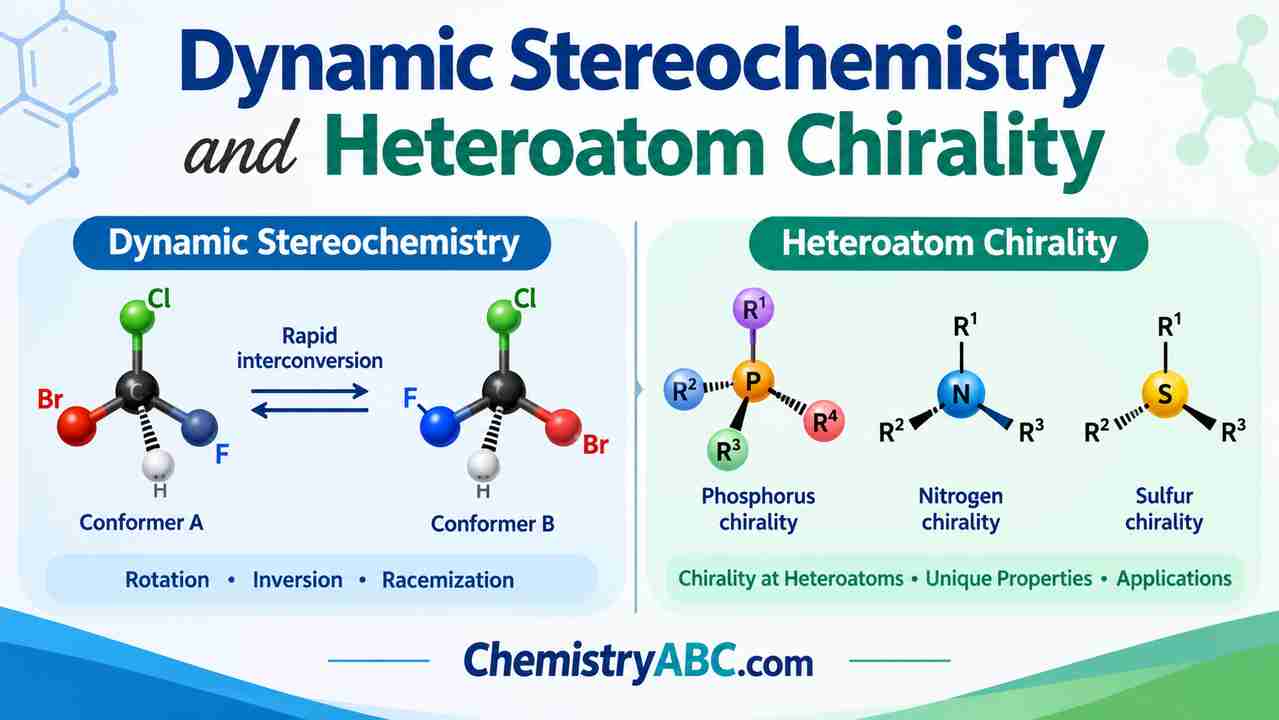
Dynamic Stereochemistry, Topicity & Heteroatom Chirality
Master lecture notes on Topicity of Ligands & Faces (Homotopic, Enantiotopic, Diastereotopic, Re/Si Descriptors), Quantitative Stereoselectivity (% ee & % de), Stereoelectronic Control in Cyclohexane Reactivity (Trans-Diaxial E2, Esterification, Oxidation), and Chiral Heteroatoms (P, N, S).
- 1. Concept of Prochirality & Topicity
- 2. Homotopic, Enantiotopic & Diastereotopic Ligands
- 3. Topicity of Faces: Re and Si Nomenclature
- 4. Stereoselectivity vs. Stereospecificity & Optical Purity (% ee)
- 5. Dynamic Stereochemistry: Conformation & Chemical Reactivity
- 6. Vector Diagram: Menthyl vs. Neomenthyl E2 Elimination (SVG)
- 7. Esterification, Saponification & Chromic Acid Oxidation
- 8. Conformations of Cyclohexanones & 2-Halocyclohexanones
- 9. Stereochemistry of Heteroatoms (P, N, and S)
- 10. High-Yield Exam Summary (CSIR NET & GATE)
- 11. Support ChemistryABC & Helpline Community
- 12. Frequently Asked Questions (FAQ)
While static stereochemistry deals with spatial geometry in the ground state (symmetry, configurations, and conformational equilibria), dynamic stereochemistry governs how molecular 3D shape, orbital alignment, and conformational flexibility dictate chemical reactivity and product distribution. In MSCCH-502 (Unit 5) and competitive examinations (CSIR NET, GATE Chemistry, SET), examiners focus heavily on the mathematical classification of topicity, stereoelectronic requirements (anti-periplanar alignments), and chiral heteroatoms.
Reactions proceed along transition-state pathways that provide maximum constructive orbital overlap. In cyclic and acyclic systems, conformational mobility allows molecules to sample various conformations; however, according to the Curtin-Hammett principle, product distribution is governed solely by the free energy difference between the competing transition states (ΔΔG‡), regardless of the ground-state conformational equilibrium populations.
1. Topicity of Ligands: Homotopic, Enantiotopic & Diastereotopic
Topicity refers to the spatial relationship between constitutionally equivalent ligands (atoms or groups) within a molecule. They are classified using two rigorous analytical methods: the Addition/Substitution Criterion (Chiral Probe Test) and the Symmetry Criterion.
| Ligand Type | Substitution Test (Replace with D) | Symmetry Criterion | NMR Behavior (Achiral Solvent) |
|---|---|---|---|
| Homotopic | Yields identical (homomeric) molecules. | Interchangeable by a proper axis of rotation (Cn, where n ≥ 2). | Isochronous (Single NMR signal) |
| Enantiotopic | Yields a pair of non-superimposable enantiomers. | Interchangeable only by an alternating axis of symmetry / plane of symmetry (σ or i or Sn). | Isochronous in achiral media; Anisochronous in chiral solvating agents. |
| Diastereotopic | Yields a pair of diastereomers (often because a chiral center already exists). | Not interchangeable by ANY symmetry operation (Cn, σ, or i). | Anisochronous (Split into distinct NMR signals even in standard achiral solvents!) |
Prochiral Descriptor Assignment: pro-R and pro-S
For enantiotopic ligands (such as the two protons of ethanol, CH3−CH2−OH):
- Arbitrarily assign higher CIP priority to one of the identical ligands (e.g., substitute HA with deuterium 2H without altering HB).
- Since 2H has a higher atomic mass than 1H, Priority: −OH (1) > −CH3 (2) > 2H (3) > 1H (4).
- If the resulting configuration is R, then the modified ligand (HA) is designated pro-R. If S, it is designated pro-S.
2. Topicity of Heterotopic Faces: Re and Si Faces
Trigonal sp2-hybridized planar centers (such as aldehydes, ketones, and unsymmetrical alkenes) possess two distinct faces toward nucleophilic or electrophilic attack:
- CIP Priority Assignment: Assign priorities (1 > 2 > 3) to the three substituents attached to the planar sp2 center according to the Cahn-Ingold-Prelog sequence rules.
- Re Face (Rectus): When viewing the face directly, if the priority sequence 1 → 2 → 3 traces a clockwise path, that face is the Re face.
- Si Face (Sinister): If the priority sequence 1 → 2 → 3 traces a counter-clockwise path, that face is the Si face.
3. Stereoselectivity, Stereospecificity & Optical Purity
Understanding product distributions requires rigorous distinction between two frequently confused terms:
- Stereospecific Reaction: A reaction in which the stereochemical mechanism strictly dictates that a stereochemically pure reactant yields 100% of a specific stereoisomeric product (e.g., anti-addition of Br2 to trans-2-butene yields purely meso-2,3-dibromobutane, while addition to cis-2-butene yields a (±)-enantiomeric pair).
- Stereoselective Reaction: A reaction where a single starting material has the choice to yield two or more stereoisomers, but one is formed preferentially due to a lower activation barrier (e.g., Felkin-Anh carbonyl reduction yielding a 90:10 ratio of diastereomers).
Quantitative Formulae for Stereoisomeric Excess
Enantiomeric Excess (% ee):
Diastereomeric Excess (% de):
4. Dynamic Stereochemistry: Conformation & Reactivity
The chemical reactivity of functional groups on a cyclohexane ring depends fundamentally on whether the substituent occupies an axial or an equatorial position.
Bimolecular Elimination (E2) & Trans-Diaxial Geometry
The E2 mechanism requires a strictly anti-periplanar arrangement between the β-hydrogen and the leaving group (dihedral angle θ = 180°). In six-membered rings, this geometry is achievable ONLY when both the leaving group (e.g., −Cl) and the β-hydrogen are trans-diaxial! Attack on an equatorial leaving group or equatorial hydrogen cannot achieve anti-periplanar alignment.
5. Esterification, Saponification & Chromic Acid Oxidation
A. Esterification and Saponification Rates
- Equatorial Carboxyl/Ester groups: Point outward into open solvent space. They experience minimal steric encumbrance during nucleophilic attack by alcohol or hydroxide ion. Consequently, equatorial esters hydrolyze faster and equatorial carboxylic acids esterify faster than their axial epimers.
- Axial Carboxyl/Ester groups: Severely hindered by 1,3-diaxial steric interactions with syn-axial hydrogens at C3 and C5, significantly raising the activation energy (ΔG‡) of the tetrahedral transition state.
B. Chromic Acid Oxidation of Cyclohexanols (Steric Acceleration)
In the oxidation of secondary cyclohexanols with CrO3 (or H2CrO4), the rate-determining step is the cleavage of the C–H bond of the chromate ester intermediate:
- An axial −OH group oxidizes significantly FASTER than an equatorial −OH group!
- Thermodynamic Driving Force: The axial −OH group experiences severe 1,3-diaxial strain. Upon oxidation to the planar, sp2-hybridized ketone (C=O), the 1,3-diaxial interactions are completely relieved! This relief of steric strain (steric acceleration) accelerates the reaction rate of axial alcohols over equatorial alcohols.
6. Conformations of Cyclohexanones & 2-Halocyclohexanones
- Cyclohexanone: Adopts a slightly flattened chair conformation. Replacing an sp3 CH2 with an sp2 carbonyl (C=O) removes two axial C–H bonds, eliminating 1,3-diaxial interactions at C3/C5 and introducing torsional modifications.
- 2-Halocyclohexanones (The 2-Halo Ketone Effect): In 2-bromocyclohexanone, the bromine atom can exist in an axial or equatorial orientation:
- In non-polar solvents (e.g., CCl4), the axial conformer predominates (~65%) because the C−Br and C=O dipoles are roughly antiparallel (pointing in opposite directions), minimizing electrostatic dipole-dipole repulsion.
- In polar solvents (e.g., water, methanol), the equatorial conformer predominates because the solvent stabilizes the high dipole moment generated by the nearly parallel C−Br and C=O dipole vectors.
7. Stereochemistry of Heteroatoms: Nitrogen, Phosphorus & Sulfur
| Heteroatom System | Inversion Barrier (ΔG‡) | Resolvability at 25 °C | Classic Chemical Example |
|---|---|---|---|
| Simple Acyclic Amines (R1R2R3N) | Very Low (~24–30 kJ/mol) | Unresolvable (Rapid Walden Umbrella Inversion, ~1011 s−1) | Ethylmethylpropylamine |
| Bridged Amines & Aziridines | Very High (> 100 kJ/mol) | Readily Resolvable (Rigid bridgehead freezes inversion) | Tröger’s Base (C2-chiral bridgehead nitrogen) |
| Quaternary Ammonium Salts | No Inversion (No lone pair) | Configurally Stable & Resolvable | [R1R2R3R4N]+ X− |
| Phosphines (R1R2R3P) | High (~125–145 kJ/mol) | Optically Stable at Room Temperature | DIPAMP, Methylpropylphenylphosphine |
| Sulfoxides (R1−SO−R2) | Very High (~150–180 kJ/mol) | Highly Resolvable (Stable up to 200 °C) | Methyl p-tolyl sulfoxide |
High-Yield Exam Points for CSIR NET & GATE
- Diastereotopic protons are chemically non-equivalent and have distinct chemical shifts (δ) in 1H-NMR even in achiral solvents (showing geminal coupling, e.g., J ≈ 12–16 Hz).
- In Menthyl Chloride, E2 elimination is 200 times slower than in Neomenthyl Chloride because Menthyl Chloride must undergo an unfavorable ring-flip to place Cl into an axial orientation, giving exclusively 2-menthene (Anti-Saytzeff).
- Axial cyclohexanols oxidize faster with chromic acid than equatorial cyclohexanols due to relief of 1,3-diaxial steric strain upon conversion to planar sp2 carbonyl.
- Tröger’s Base possesses two chiral bridgehead nitrogen atoms that cannot invert due to severe ring strain in the bicyclic framework, making it resolvable into stable enantiomers.
- In chiral phosphines and sulfoxides, the 3s/3p hybrid lone pair has a substantially higher inversion barrier than the 2s/2p lone pair in amines, making phosphines and sulfoxides configural stereocenters.
Support ChemistryABC & Student Mentorship
Help us keep educational study materials 100% free for all students • Direct Mentor Guidance
ChemistryABC provides free master study notes, previous year question papers, and CBT mock tests. If our educational materials have helped you in your M.Sc. or competitive exam preparation, consider supporting our mission via UPI:
Frequently Asked Questions (FAQ)
Diastereotopic protons reside in chemically non-equivalent diastereomeric environments. In 1H-NMR spectroscopy, they display different chemical shifts (δ) and mutually couple (exhibiting geminal coupling, typically J ≈ 12–16 Hz) even in achiral solvents.
In menthyl chloride, chlorine is equatorial in the stable conformer. To achieve the required anti-periplanar (trans-diaxial) geometry for E2 elimination, it must flip into a high-energy chair where all groups are axial. In this conformer, only C2 has an axial hydrogen; the hydrogen at C4 is equatorial and cannot eliminate, giving 100% 2-menthene (anti-Saytzeff regiochemistry).
Simple amines have a very low inversion barrier (~25 kJ/mol) and undergo rapid Walden umbrella inversion at room temperature. Phosphines utilize 3p/3s orbitals with higher s-character in the lone pair and significant angle strain in the planar transition state, raising the inversion barrier to ~130 kJ/mol, which prevents spontaneous inversion at room temperature.